WhatsApp is now the most-used messaging app on the planet — about 3.3 billion monthly active users sending more than 100 billion messages a day. I run ChatToPDF, so I spend my days at the messy end of those numbers: the people who need one specific conversation out of the app and discover WhatsApp won't hand it to them in any usable shape. This page pulls the WhatsApp statistics that actually matter for that, and explains why the raw export leaves most people stuck.
Why these numbers matter to me
I didn't set out to collect WhatsApp statistics. I started building ChatToPDF because I needed one chat as a document and couldn't get it, and the numbers only became interesting once I saw the same problem land in my inbox over and over. Someone in India needs eight years of messages for a property dispute. A parent in the UK needs a custody thread their solicitor can actually read. A person in Brazil wants to keep the last conversation they had with a parent who passed away. Different countries, different reasons, identical wall: the chat is huge, it lives inside an app, and the app will only give it back as a text dump.
When you sit with the scale of WhatsApp for a while, that pattern stops looking like a niche complaint. If billions of people send tens of billions of messages a day, then a small percentage needing to preserve a single conversation is still an enormous number of people — and almost none of them are served by the export WhatsApp ships. So I treat these statistics as a map of the demand, not trivia. The sections below are the figures I come back to, with sources, and what each one means in practice for getting a chat out of WhatsApp and into something you can keep.
How many people use WhatsApp
As of early 2026, WhatsApp has roughly 3.3 billion monthly active users, according to DemandSage. That makes it the largest messaging app in the world by a wide margin, ahead of Facebook Messenger, Telegram and Signal.
Monthly users are one number; daily users are the more telling one. Around 2.4 billion people open WhatsApp every day — close to three-quarters of the monthly base. A messaging app people return to daily is a different kind of habit than an app they check now and then, and it is why so many important conversations — family logistics, work handovers, money owed, custody arrangements — end up living inside it.
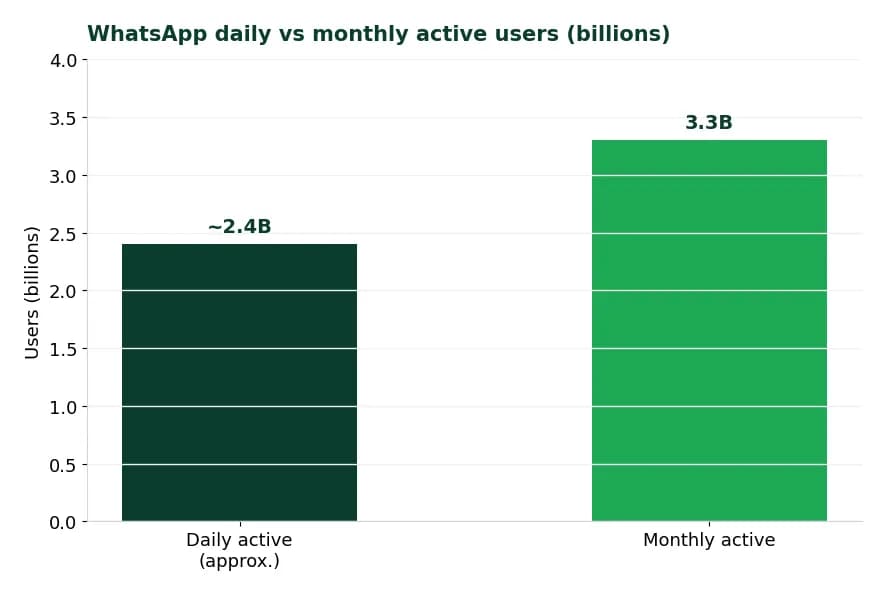
That daily habit is the reason people eventually need an export. A chat you use every day for two years is not something you can scroll back through or screenshot when you suddenly need it on paper.
How fast it grew
WhatsApp crossed 2 billion monthly users in February 2020. It added another 1.3 billion in roughly five years, passing 3 billion in early 2025 and reaching about 3.3 billion by January 2026 (Backlinko).
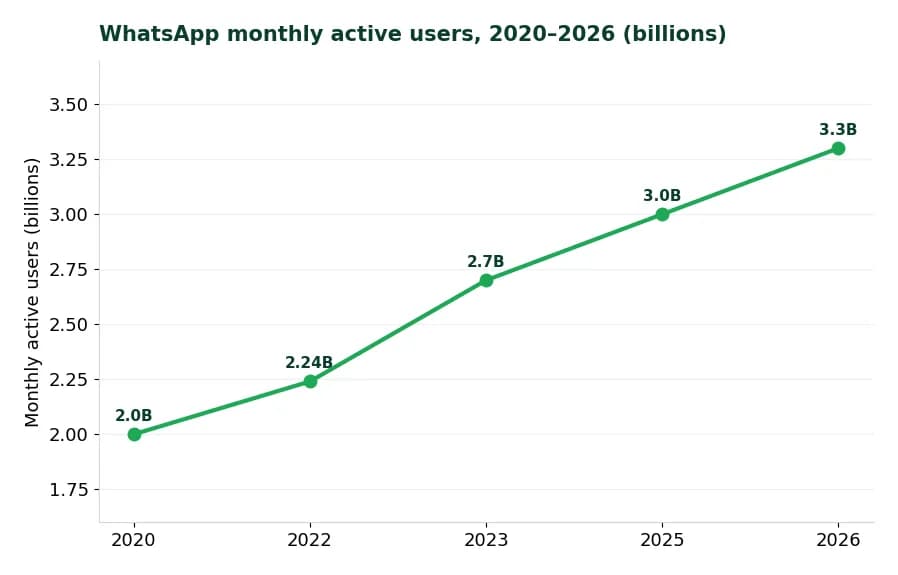
The steady climb matters for one practical reason: the longer the app has been the default, the longer the average chat history is. People are now exporting threads that span five, eight, ten years — far beyond what a few screenshots can capture, and well into the range where you need a real document with dates and sender names.
Where WhatsApp users are
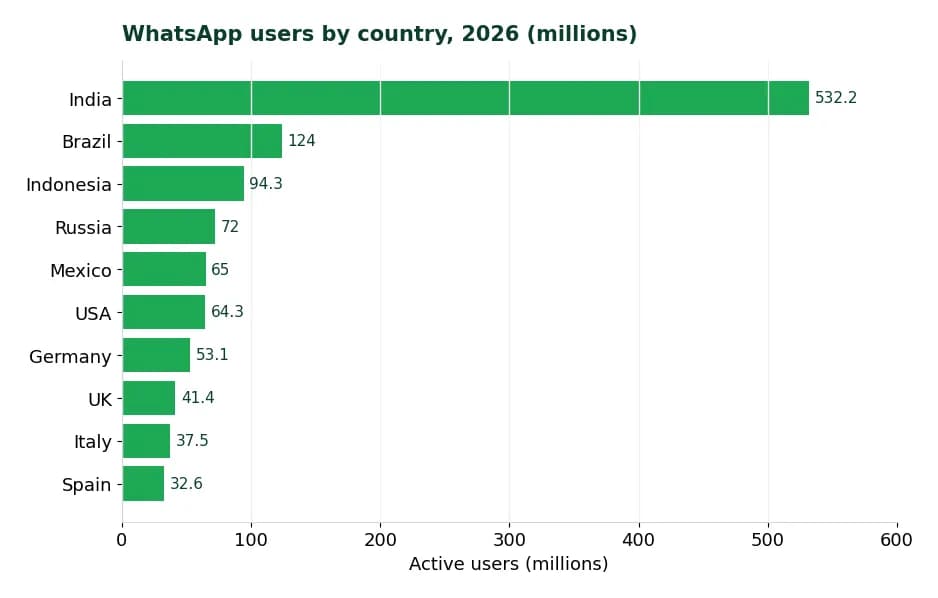
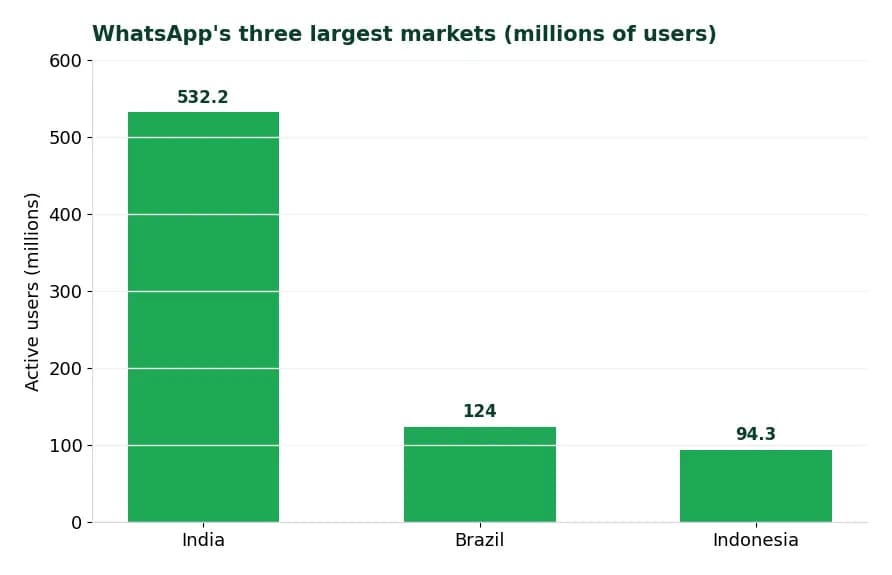
WhatsApp is not evenly spread. A handful of countries account for most of its users. India is the clear leader with about 532 million users, followed by Brazil and Indonesia (World Population Review).
The top three markets alone are striking once you put them side by side.
Add the rest of the top ten and you reach about 1.62 billion users — close to half of everyone on the platform.
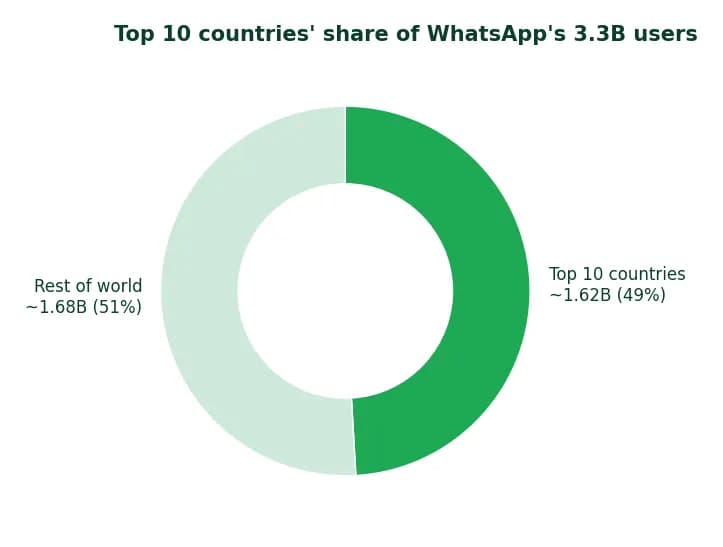
This concentration is why ChatToPDF supports the date and number formats those regions actually export in: Indian, Brazilian and European WhatsApp exports each timestamp messages differently, and a parser that only handles US formatting quietly mangles half the world's chats. We cover that in detail in the WhatsApp to PDF guide and the chat export walkthrough.
Messages and voice notes per day
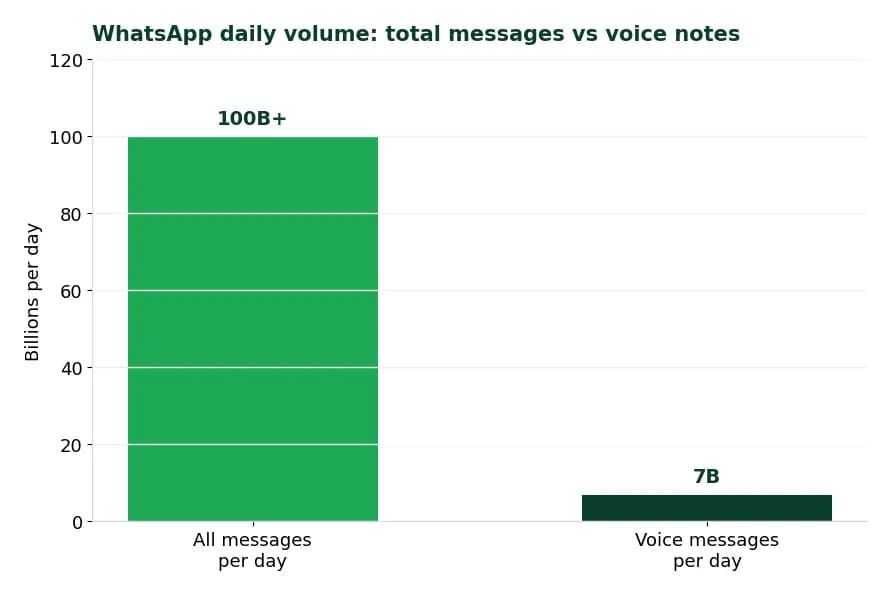
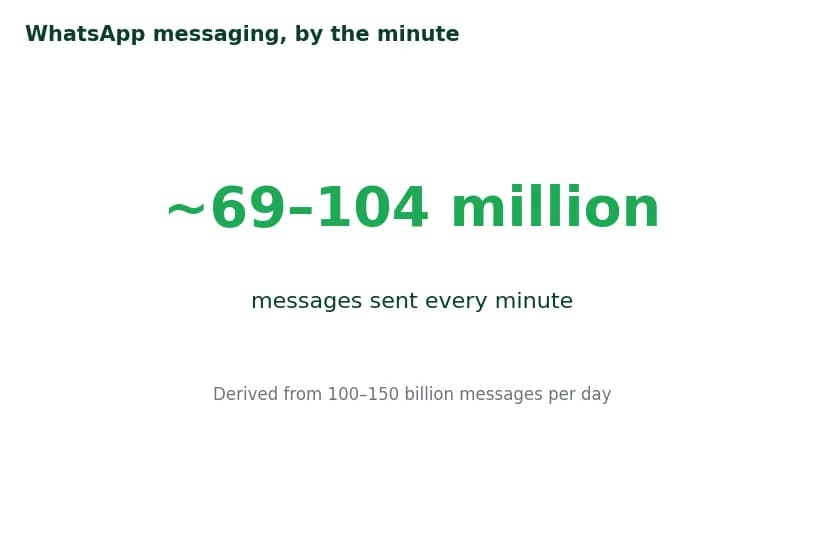
WhatsApp users send more than 100 billion messages a day, a figure Meta has stated publicly. Counting media, that number runs as high as 150 billion.
Spread across a day, that works out to tens of millions of messages a minute.
Volume at this scale is the quiet reason exports are hard to read. A two-year chat between two active people can hold tens of thousands of messages. WhatsApp itself caps a media-inclusive export at about 40,000 messages, and even an export that fits is a wall of plain text without a tool to format it.
There is a second-order effect worth naming. The more a chat is used, the more it interleaves text, photos, replies and voice notes — so the raw .txt ends up peppered with placeholder lines like <Media omitted> where the interesting parts used to be. A screenshot misses the dates; a print-to-PDF of WhatsApp Web breaks the layout after a few hundred messages; copy-pasting into a document strips the sender attribution. None of the quick workarounds survive contact with a genuinely active chat, which is exactly why a parser that rebuilds the structure — who said what, when, with which photo attached — is the only thing that scales to these numbers.
Why voice-note volume matters
Of all those daily messages, about 7 billion are voice notes — which WhatsApp has said makes it the largest voice-messaging platform in the world.
"WhatsApp users send over 7 billion voice messages a day." — WhatsApp
Voice notes are the part of a chat that no screenshot and no plain-text export can preserve as something readable. The export hands them over as raw .opus audio files, not text. Turning those into searchable transcripts inline with the rest of the conversation is its own problem, which is the whole subject of the voice transcription guide.
What the export actually gives you
Here is the gap behind every statistic above. For all 3.3 billion users, WhatsApp's only built-in way to get a conversation out is Export Chat, and it produces a .txt file or a .zip — never a PDF.
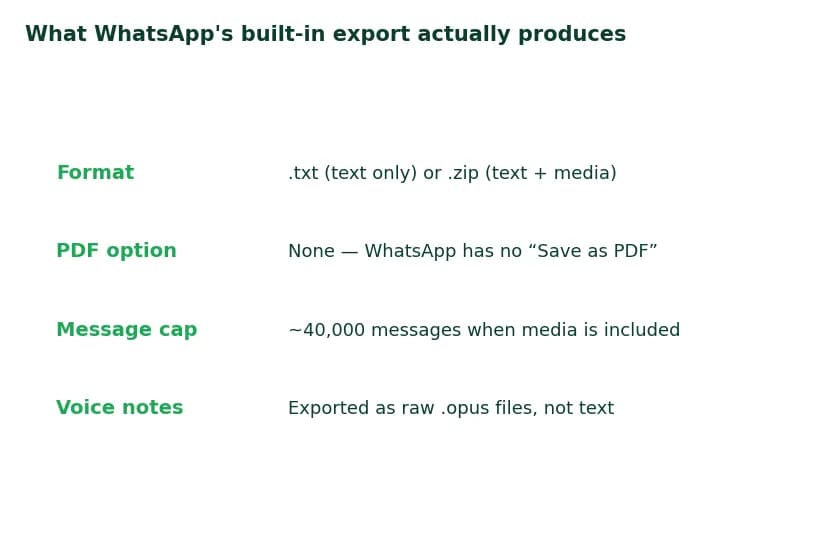
So the messages exist, the demand to keep them exists, but the format is unreadable for any real purpose: a court bundle, a keepsake, a record before switching phones. That last case — preserving a thread that may later be needed as evidence — is common enough that we wrote a separate guide on using WhatsApp messages in court.
What surprised me, once I started measuring it, is how little the export format has changed even as the user base tripled. The _chat.txt file you get in 2026 looks almost identical to the one from years ago: the same timestamp-then-sender-then-message lines, the same media placeholders, the same lack of any structure a person would want to read. The platform grew to 3.3 billion people; the way it lets those people take their own words with them did not keep pace. That mismatch — billions of users, a stagnant export — is the entire reason a formatting tool needs to exist at all.
ChatToPDF takes that raw export and turns it into a clean, dated, sender-attributed PDF — images inline, voice notes transcribed — with a free preview before you pay.
Sources
Figures on this page are drawn from public industry compilations as of 2026, primarily DemandSage, Backlinko and World Population Review, plus WhatsApp's own public statements on daily message and voice-note volume. Numbers are rounded and reflect the latest available reporting; messaging-platform figures shift over time, so treat them as current estimates rather than audited counts.
How many people use WhatsApp in 2026?
WhatsApp has roughly 3.3 billion monthly active users as of early 2026, with about 2.4 billion using it daily. That makes it the most-used messaging app in the world, ahead of Messenger, Telegram and Signal.
How many messages are sent on WhatsApp every day?
More than 100 billion messages a day, a figure Meta has stated publicly — rising to around 150 billion when media is counted. About 7 billion of those are voice notes.
Which country has the most WhatsApp users?
India, with about 532 million users, far ahead of Brazil and Indonesia. The top ten countries together account for roughly 1.62 billion users, close to half the platform.
Can WhatsApp export a chat as a PDF?
No. WhatsApp's built-in Export Chat only produces a .txt file or a .zip with media — there is no PDF option, and a media-inclusive export is capped at about 40,000 messages. A converter like ChatToPDF turns that export into a formatted PDF.
Key takeaways
- WhatsApp has ~3.3 billion monthly and ~2.4 billion daily users in 2026.
- Users send 100 billion+ messages and 7 billion voice notes a day.
- India (532M), Brazil and Indonesia are the largest markets; the top 10 hold ~49% of users.
- WhatsApp's own export gives only
.txt/.zip, no PDF — the gap ChatToPDF fills.
I'm Paul, the founder of ChatToPDF. I built it after needing a long WhatsApp conversation as a readable PDF for a legal matter. I test and document WhatsApp exports, PDF conversion, voice-note transcription, and the limits people should check before relying on the result.