What people searching "iLovePDF WhatsApp" actually want
I see the same search every week in Google Search Console: "ilovepdf whatsapp", "i love pdf whatsapp", and the typo variants — "watsapp love pdf", "whats up to pdf", "ilovepdf whatsapp to pdf". The people typing those queries land on chattopdf.app, which tells me two things. First, they have heard of iLovePDF — it has been around for years, it is one of the most-recognised PDF utilities online, and "iLovePDF" is the brand name they reach for whenever PDFs come up. Second, the thing they actually want to do is turn a WhatsApp conversation into a PDF, and somewhere in the back of their head they have stitched those two ideas together: PDF tool plus WhatsApp equals the answer.
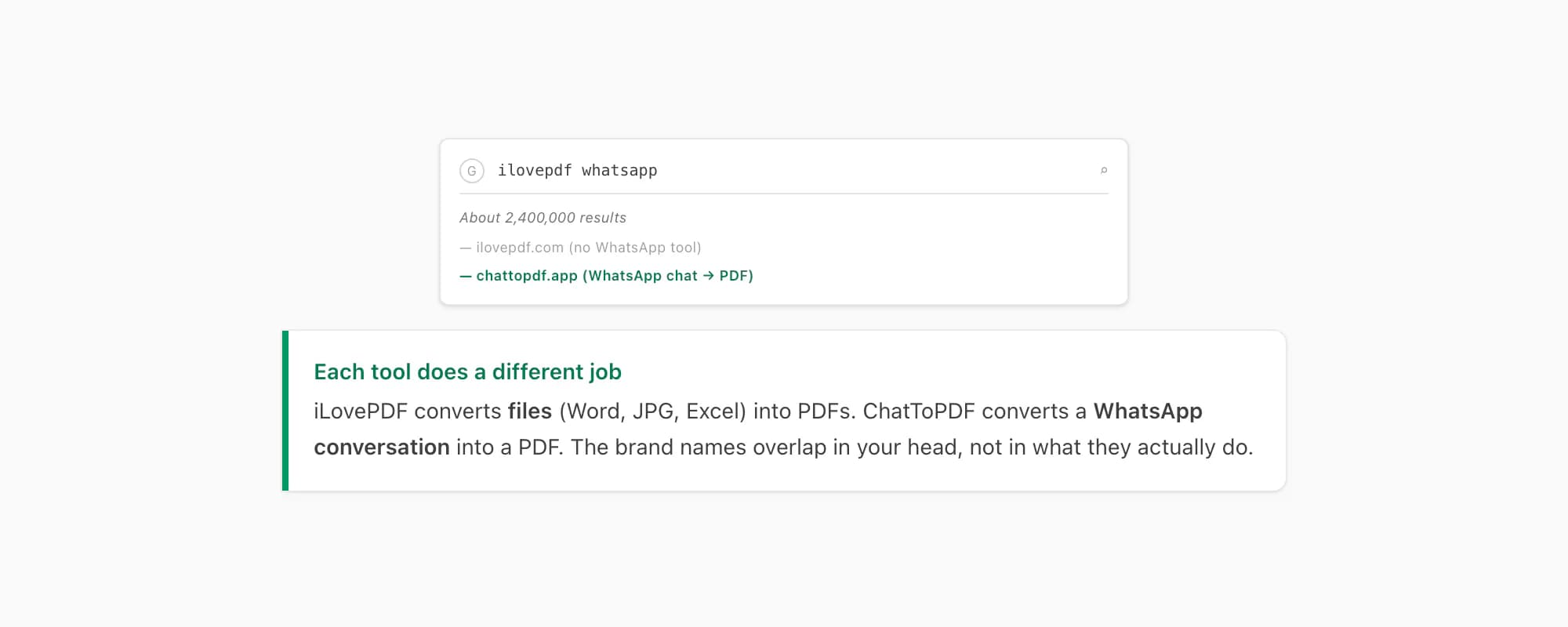
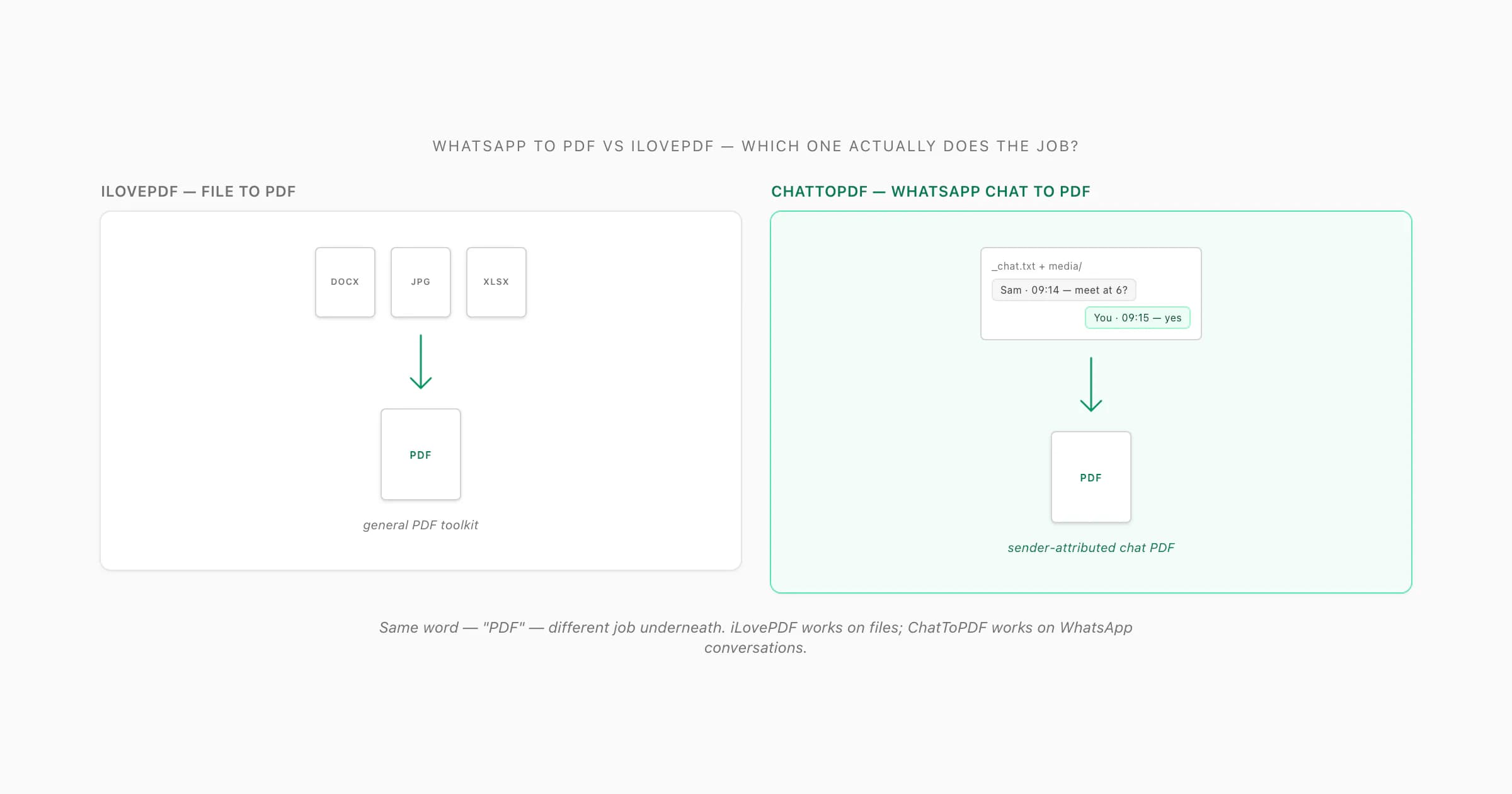
It is a perfectly reasonable mental model, but the two tools genuinely do different jobs. iLovePDF is a general PDF toolkit — it works on PDF files and on other file formats that need to become PDFs. ChatToPDF is a WhatsApp-specific pipeline — it takes WhatsApp's _chat.txt (or the full export ZIP with media) and produces a paginated, sender-attributed, timestamped chat document. There is no overlap in the input format and there is no overlap in the output. Once you see that, the choice gets simple — which is what this whole comparison is about.
What iLovePDF actually does (and is genuinely good at)
I want to give iLovePDF its due before I draw any contrast. As of 2026, the iLovePDF toolkit on ilovepdf.com is one of the most-used free PDF utilities on the web, and for good reason. The tool set is broad and the workflows are straightforward.
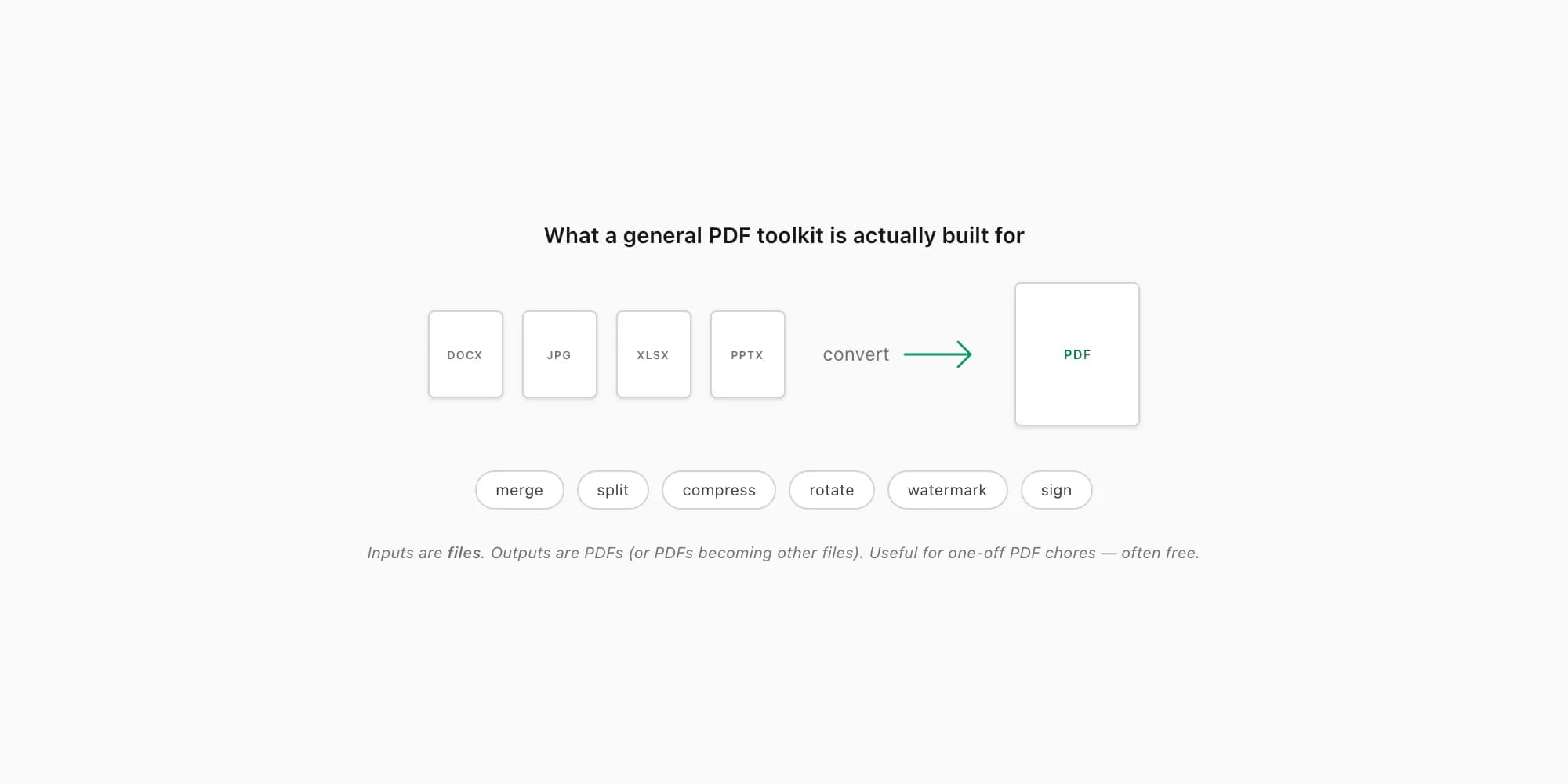
The things iLovePDF does well, and which most people use it for:
- Convert files to PDF. Drop a Word document, an Excel spreadsheet, a PowerPoint deck, or a stack of JPGs onto the page and it gives you back a PDF. This is the canonical use case: you have a file, you want it to become a PDF, iLovePDF handles it.
- Merge multiple PDFs into one. A common archive-and-share task — combine a stack of invoices, or a multi-page scan, into a single file.
- Split a PDF into parts. The inverse — extract a page range, or break a large file into smaller ones.
- Compress a PDF. Reduce the file size so it fits an email attachment limit or a portal upload cap, with the quality trade-off you would expect.
- Convert PDFs to other formats. PDF to Word, PDF to JPG, PDF to PowerPoint — the reverse direction of the toolkit's main verb.
- Sign, watermark, page-number, rotate, unlock and protect PDFs. The long tail of one-off PDF housekeeping tasks that come up at the end of a project.
The pricing model on iLovePDF, as of 2026, is a free tier with per-day usage and file-size limits plus a paid plan billed periodically that lifts those limits and unlocks the heavier tools (verify on iLovePDF's current pricing page for exact figures and billing cadence — they update from time to time). For the great majority of one-off household and small-business PDF chores, the free tier is enough — that is part of why the brand has the recognition it does.
None of this involves WhatsApp. Nowhere in the iLovePDF toolkit, as far as I have been able to verify on their live site, is there a "WhatsApp chat export" handler — no input that accepts a _chat.txt, no parser for WhatsApp's export ZIP, no rendering pipeline that knows what a sender attribution or a timestamp inside a WhatsApp message looks like. The toolkit is shaped around files, not conversations.
What turning a WhatsApp chat into a PDF actually requires
This is the part that explains why a general PDF toolkit cannot do the chat job, even if you tried to stretch it. A WhatsApp chat is not a "file" in any normal sense — it is a stream of messages, and the export WhatsApp gives you is a peculiar text format with a separate folder of media attachments.
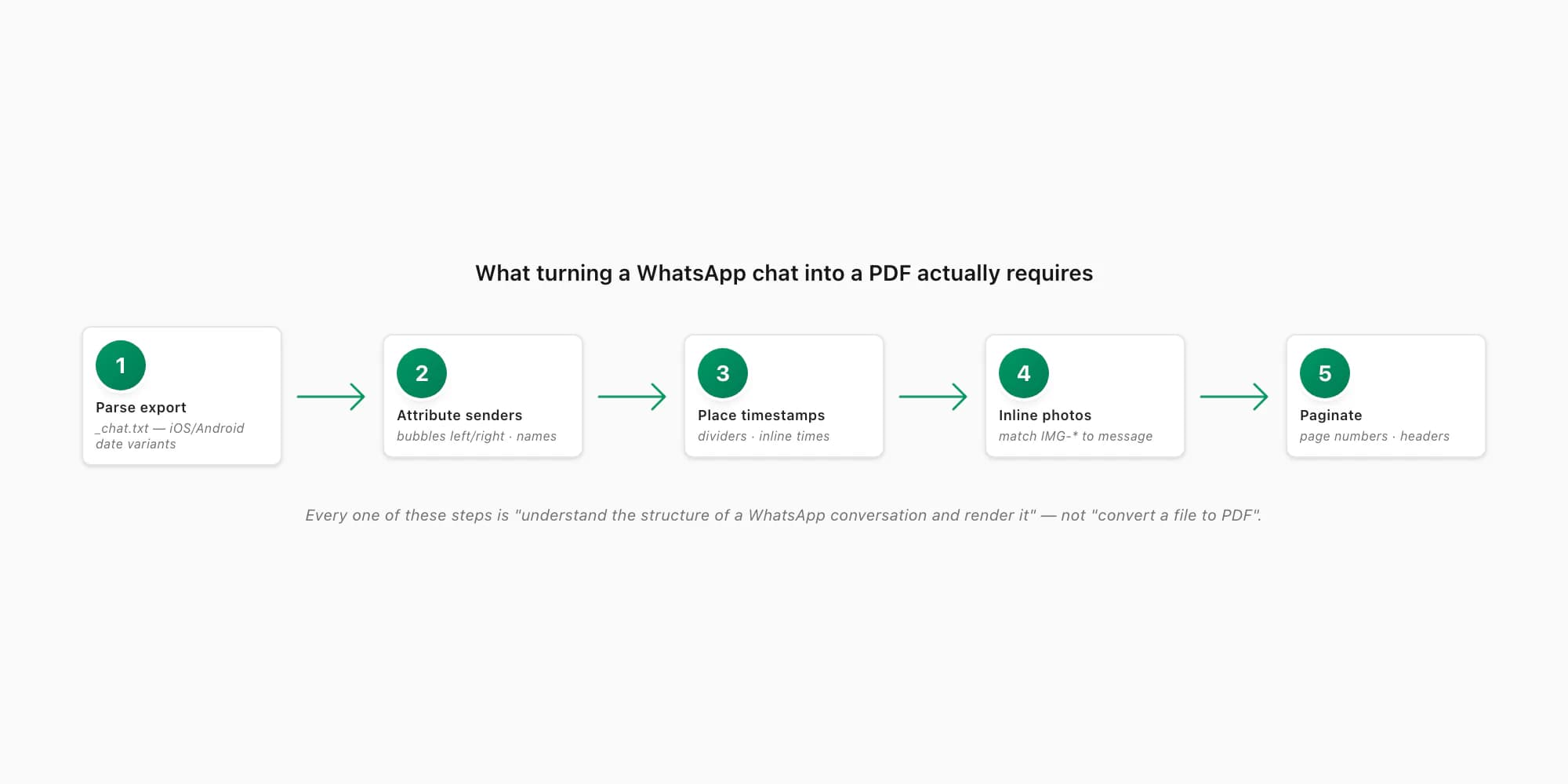
To turn that into the document people actually want, the pipeline has to:
- Parse the WhatsApp export. The
_chat.txtis a quirky line-based format. Every line is[date, time] sender: message, with regional variations for the date order, the time separator, the 12/24-hour clock, the brackets, and how multi-line messages continue onto the next line. There is a reason there is no universal parser library for it. - Attribute every message to a sender. Bubbles on the left for the other participant, bubbles on the right for "you" — and in a group chat, a third, fourth, fifth colour. The PDF cannot just dump the raw text; it has to render the conversational structure.
- Place timestamps cleanly. Inline, between message clusters, or in a margin — whichever the reader will scan most easily. Date dividers when a new day starts. None of that is in the raw export; the renderer has to compute it.
- Inline the photos. WhatsApp's ZIP gives you
IMG-20250403-WA0001.jpg-style filenames and a<media omitted>placeholder in the text. The renderer has to match every reference to the right file and lay it out at the right size next to the right message. - Optionally transcribe voice notes. The
.opusfiles are not useful to a reviewer who is not going to play each one. The WhatsApp audio-to-text workflow processes supported notes on a voice-enabled tier and returns successful transcripts to the document; that is its own subprocess. - Paginate the output. Long chats can be tens of thousands of messages. The PDF has to break cleanly across pages, with headers and page numbers, so a 600-page chat is actually readable.
None of those steps is "convert a file to PDF". Every one of them is "understand the structure of a WhatsApp conversation and render it". A general PDF toolkit has no idea what any of that is — and that is not a knock on iLovePDF; it is just that the tools were never built for that job.
Side by side — the feature matrix
Here is the honest, row-by-row contrast between what each tool will do for a person who has a WhatsApp chat they want as a PDF. I have stuck to verifiable claims about iLovePDF — features they list on their site as of 2026 — and hedged anywhere I am not 100% sure of a current figure.
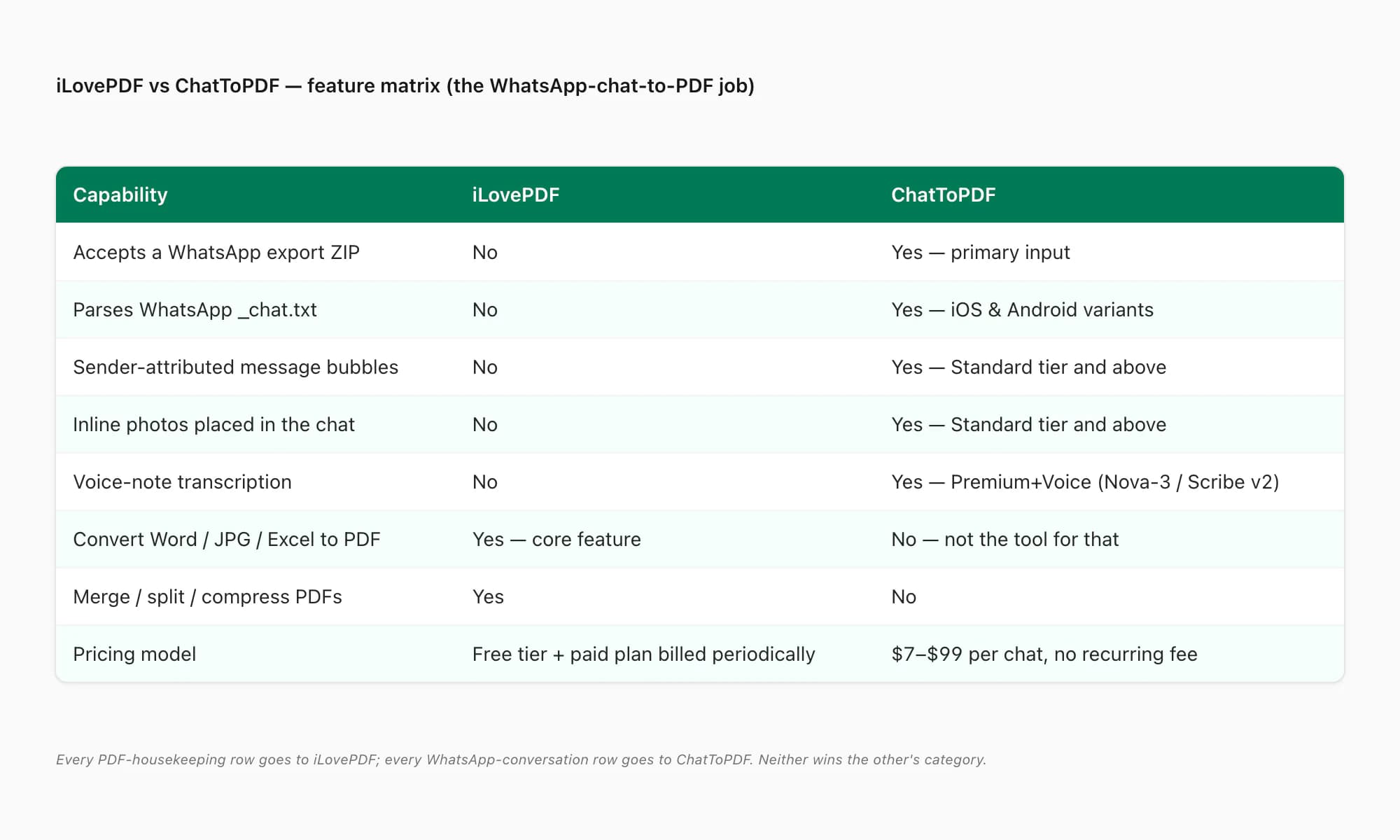
| Capability | iLovePDF | ChatToPDF |
|---|---|---|
| Accepts a WhatsApp export ZIP | No | Yes — primary input |
| Parses WhatsApp's _chat.txt format | No | Yes — handles iOS and Android variants |
| Sender-attributed message bubbles | No | Yes — on $14 Standard per chat and above |
| Inline photos placed in the conversation | No | Yes — on $14 Standard per chat and above |
| Voice-note transcription | No | Yes — $49 Premium+Voice (Nova-3/Scribe v2 router) |
| Convert a Word / JPG / Excel file to PDF | Yes — core feature | No — not the tool for that job |
| Merge / split / compress PDFs | Yes | No |
| Install required | No — browser, with optional apps | No — browser only |
| Pricing model | Free tier + paid plan billed periodically | Per chat — $7 to $99 per chat, no recurring fee |
The pattern is clear: every row about "PDF housekeeping on files" goes to iLovePDF; every row about "WhatsApp conversation rendered as a document" goes to ChatToPDF. Neither tool wins the other's category.
When iLovePDF is the right tool
I am genuinely happy to send people to iLovePDF when it is the right call. Some examples I run into:
- You have a Word document and you want it as a PDF. Drop it on iLovePDF, take the PDF, done. Free, fast, no fuss.
- You have a stack of JPG receipts and want one merged PDF. Same tool — JPG-to-PDF, then merge, then download.
- You need to compress a PDF below an email attachment cap. iLovePDF's compress tool is good at this and is usually free for a typical file size.
- You want to remove a page, add a page number, or watermark a PDF you already have. General PDF housekeeping. iLovePDF.
- You need to convert a PDF back to a Word document for editing. Reverse direction — that is also iLovePDF's territory.
For any of those, the answer is iLovePDF (and is often free). I do not pretend to compete on that job and I do not want to — those are not the problems ChatToPDF was built for, and iLovePDF is genuinely good at them.
What I would not use iLovePDF for is the one thing this whole comparison exists for: turning a WhatsApp conversation into a sender-attributed PDF. There is no way to feed a WhatsApp export ZIP into iLovePDF and get the conversation rendered. You can pull individual screenshots out of the chat and convert those to PDF — and that gets you a stack of image pages with no message structure, no continuous flow, no searchability, no inline metadata. It is not the same document.
How ChatToPDF does the chat-to-PDF job
If the job you actually have is the conversation one, here is the path. It is short — three real steps, plus the export.
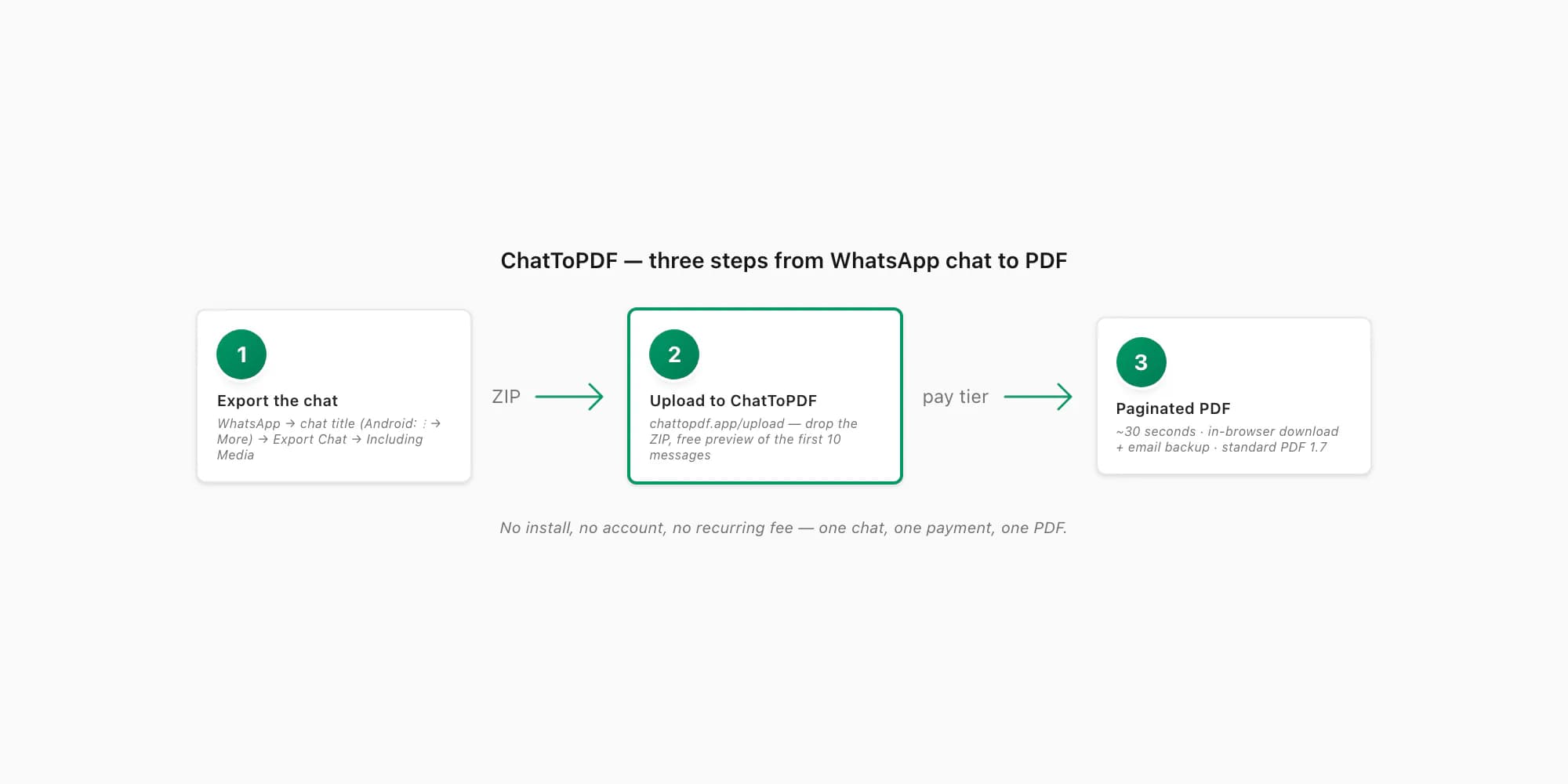
Export the chat from WhatsApp
Open the chat in WhatsApp. On iPhone, tap the contact or group name at the top, scroll to Export Chat. On Android, tap the three-dot menu, then More → Export Chat. Pick Including Media so photos make it in (the ZIP will be larger; that is fine). WhatsApp produces a
.zipcontaining_chat.txtand every media file in the conversation.Upload the ZIP to ChatToPDF
Open chattopdf.app/upload in any browser — mobile Safari, Chrome, Firefox, Samsung Internet all work. Drop the ZIP onto the upload zone. You will see a free preview of the first ten messages so you can confirm the parser read your export correctly before you pay anything.
Pick a tier and pay per chat
Choose $14 Standard per chat for the typical case — sender-attributed bubbles, inline photos, timestamps, up to 25,000 messages. $7 Basic per chat is text-only for short photo-less chats. $29 Premium per chat removes the message ceiling and adds an XLSX/CSV export. $49 Premium+Voice per chat adds voice-note transcription through the language-aware Nova-3/Scribe v2 router. $99 Power User per chat adds a priority queue for very large chats.
Download the PDF (and get the email backup)
The conversion runs in about thirty seconds. You get the download link in-browser and an email backup in case your tab closes. The output is standard PDF 1.7 — it opens in iOS Quick Look, Android file managers, Adobe Acrobat, Chrome, Safari, Firefox, Edge and macOS Preview without any extra reader.
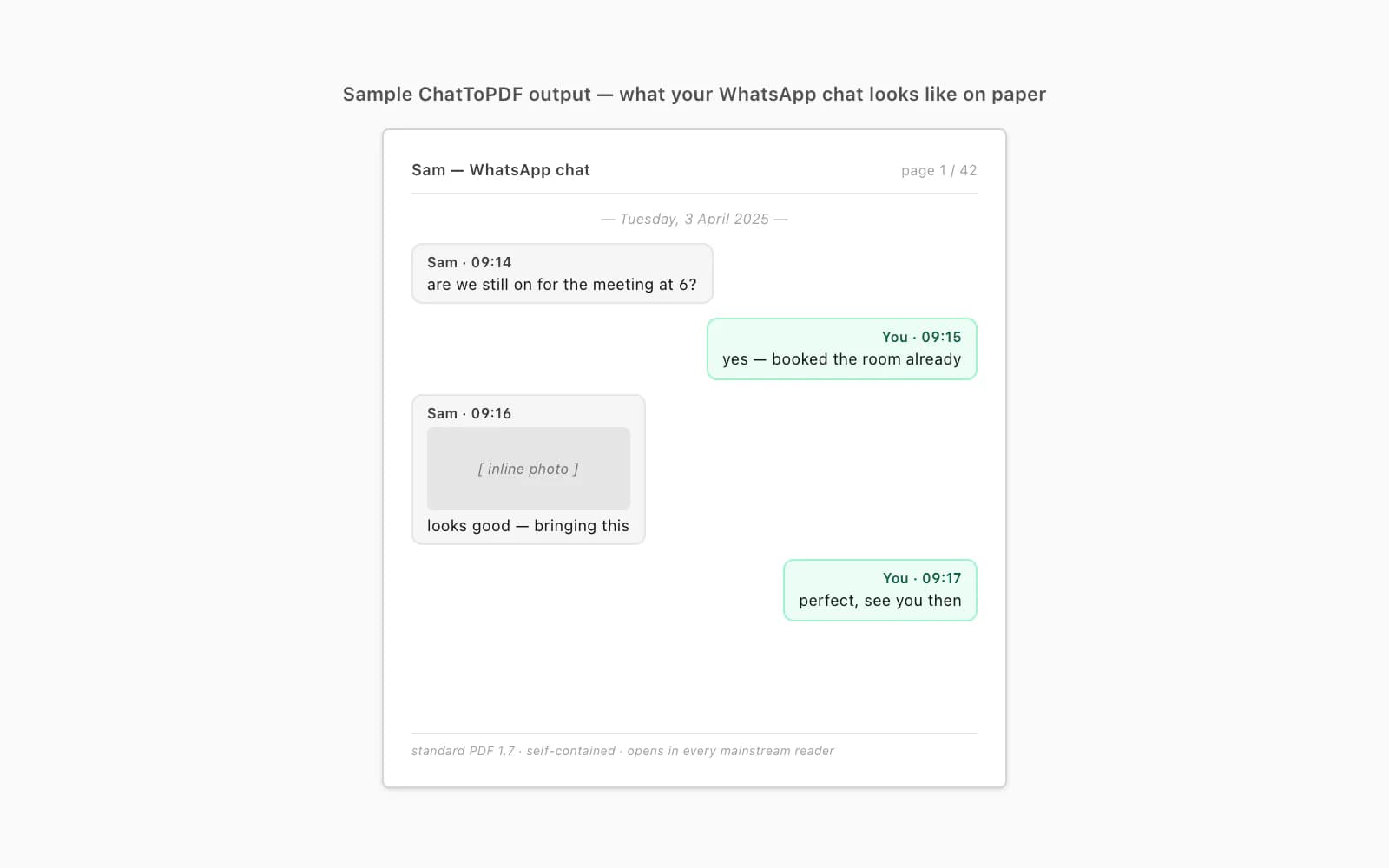
The output looks like a chat ought to look on paper — bubbles, names, times, photos inline at the right place, page numbers, a header on each page so a 600-page export still feels navigable. That is the document people are actually after when they type "iLovePDF WhatsApp" into Google.
Pricing — free, per chat, recurring
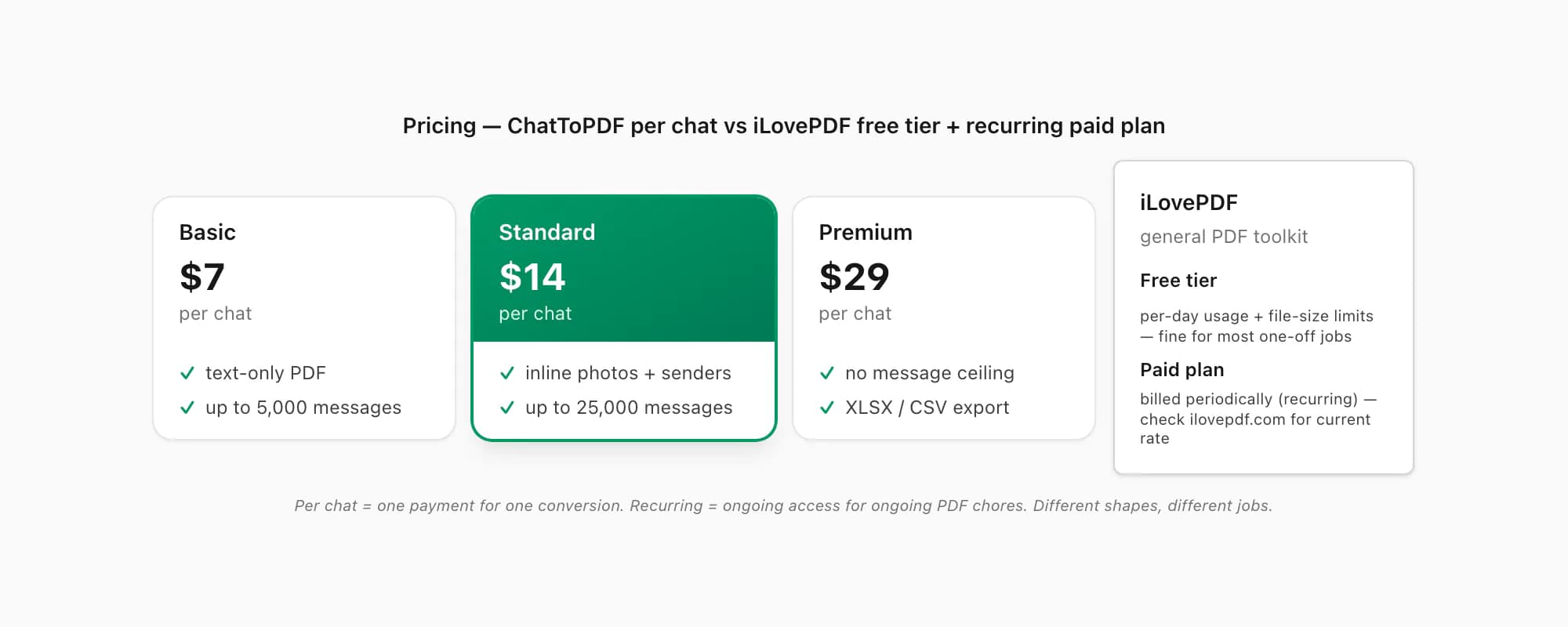
Here is how the money side compares, with the hedge that I have done my best to verify iLovePDF's pricing against their site as of 2026 — go check their pricing page yourself before you commit to anything.
iLovePDF. As of 2026, iLovePDF offers a free tier with per-day usage limits and per-file size limits, plus a paid plan billed periodically that raises those limits and unlocks the heavier tools. For one-off household PDF jobs the free tier is usually enough. The paid plan is a recurring fee — not a per-job charge — so you are paying for ongoing access whether or not you use the toolkit every month. Check the live pricing page for current numbers.
ChatToPDF. Priced per chat conversion, no recurring fee, no auto-renewal, no account. You pay once for one chat. Five tiers:
- $7 Basic per chat — text-only PDF, up to 5,000 messages. For a short chat with no photos worth keeping.
- $14 Standard per chat — sender-attributed bubbles, inline photos, timestamps, up to 25,000 messages. The usual pick.
- $29 Premium per chat — no message ceiling, plus an XLSX/CSV export alongside the PDF.
- $49 Premium+Voice per chat — adds language-aware voice-note transcription. The current product registry lists 93 languages, with 57 in its excellent or high accuracy bands; coverage is not an accuracy guarantee.
- $99 Power User per chat — priority queue and bulk handling for very large group exports.
That difference — recurring vs per chat — is the most honest framing of which tool you want. If you have a stream of PDF housekeeping tasks every month, iLovePDF's recurring paid plan can be a fair trade. If you have one WhatsApp chat you want as a document and you do not want a recurring fee on your card for it, ChatToPDF is shaped for that exact transaction. Lateral comparisons to other chat-to-PDF tools live on the ChatToPDF vs Smallpdf page and the ChatToPDF vs screenshotting page. If your chat PDF is also misbehaving inside WhatsApp itself, the WhatsApp not opening PDF guide walks the five causes.
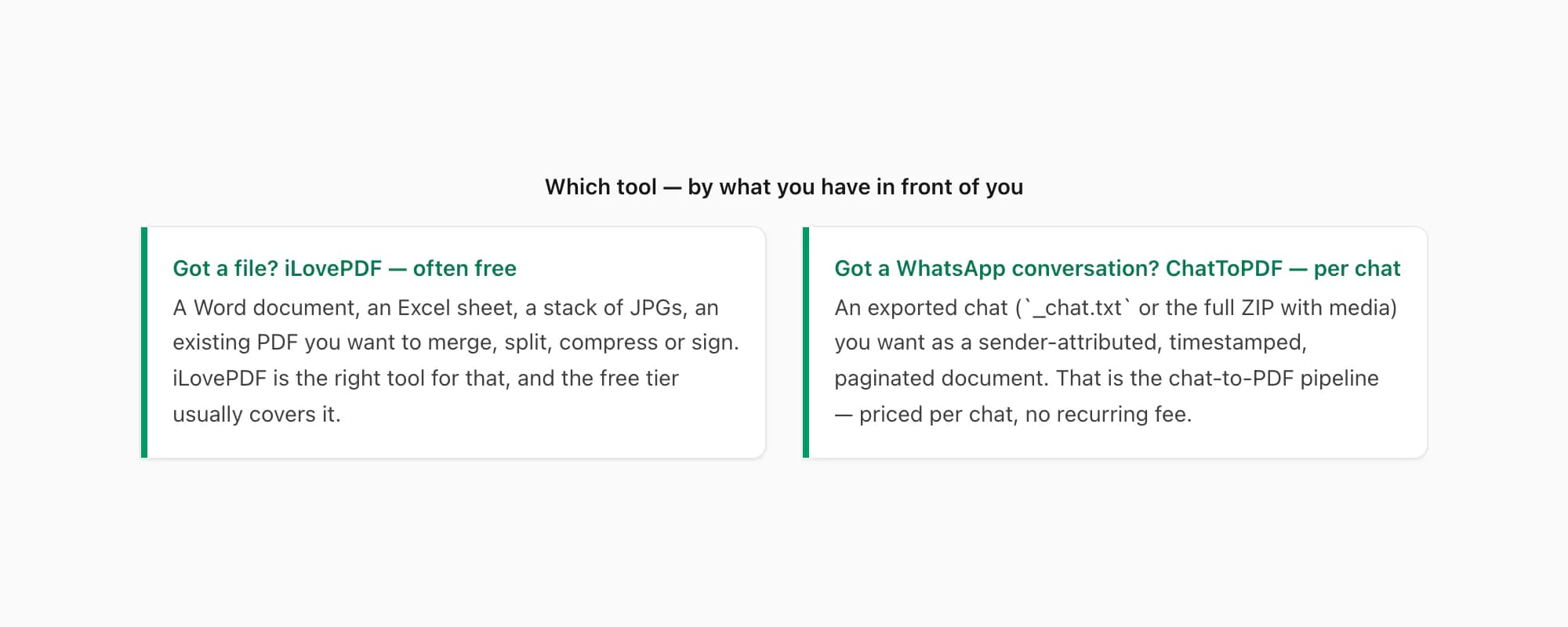
The honest bumper sticker: got a file, use iLovePDF. Got a WhatsApp conversation, use ChatToPDF. Same shape of word — "PDF" — different job underneath.
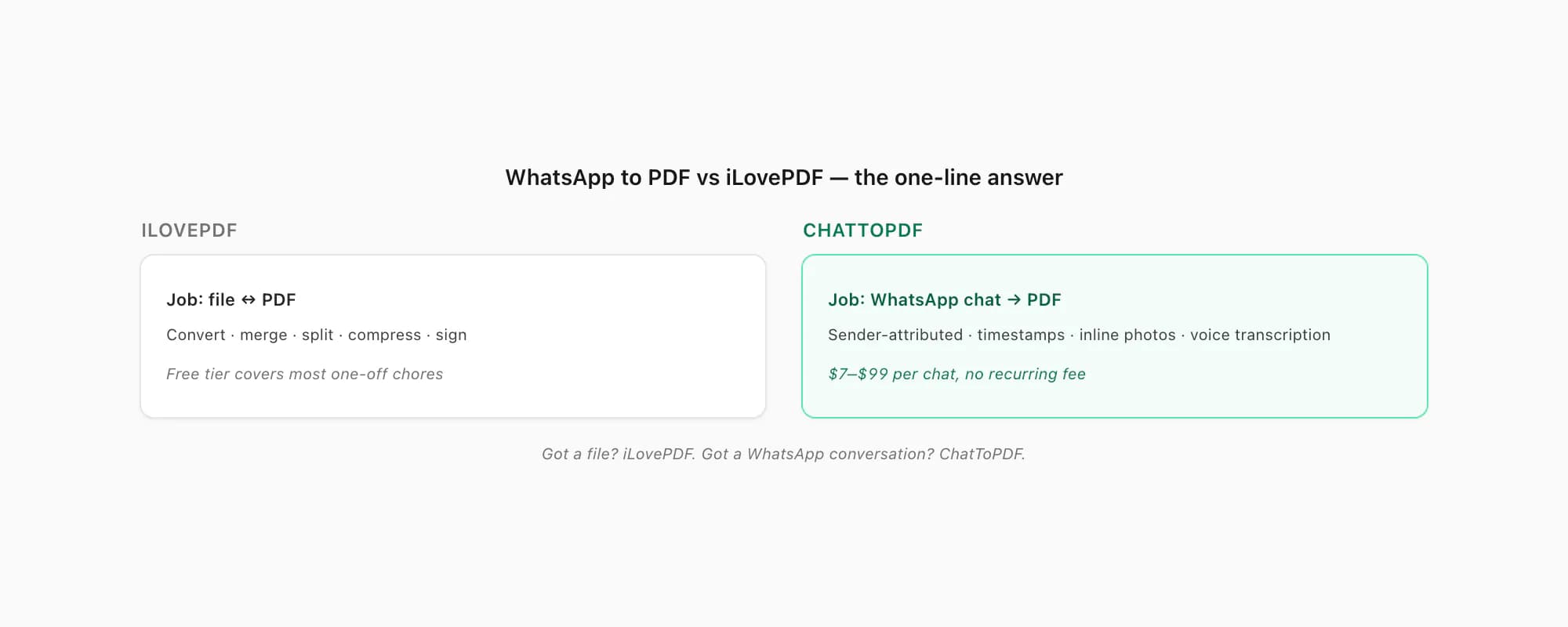
Key takeaways
- WhatsApp to PDF vs iLovePDF is a clean split once you separate the inputs: iLovePDF works on files (Word, JPG, Excel, existing PDFs), ChatToPDF works on WhatsApp chat exports
- iLovePDF is a great general PDF toolkit — convert, merge, split, compress, sign — and the free tier is enough for most one-off PDF chores
- iLovePDF has no WhatsApp chat-export pipeline — it cannot take a
_chat.txtor an export ZIP and produce a sender-attributed PDF - ChatToPDF is priced per chat — $7 Basic per chat to $99 Power User per chat, one payment covers one chat, no recurring fee
- iLovePDF's paid plan is a recurring fee for ongoing access; ChatToPDF is a one-off per-conversion charge — different shapes, different jobs
- If you have a Word, JPG or Excel file to convert to PDF, go to iLovePDF — it is the right tool and often free
- If you have a WhatsApp conversation you want as a paginated, sender-attributed document, that is ChatToPDF's job
FAQ
Can iLovePDF convert a WhatsApp chat to PDF?
Not directly. As of 2026, iLovePDF's toolkit accepts file inputs — Word, Excel, PowerPoint, JPG, existing PDFs — and converts, merges, splits, compresses or otherwise transforms them. It does not have a WhatsApp chat-export handler: there is no input that takes WhatsApp's _chat.txt or the full export ZIP and renders a sender-attributed, paginated chat document. People searching "ilovepdf whatsapp" who want the chat as a PDF are looking for what ChatToPDF does — a WhatsApp-specific pipeline priced per chat.
Is iLovePDF free, and what are the limits?
As of 2026, iLovePDF offers a free tier with per-day usage and per-file size limits, plus a paid plan billed periodically that raises those limits and unlocks the heavier tools. For one-off household and small-business PDF jobs — convert a Word to PDF, merge a few invoices, compress a scan to email — the free tier is usually enough. The exact daily-task count and file-size ceilings change from time to time, so check the current pricing page on iLovePDF directly before you commit.
Why does ChatToPDF charge per chat instead of a recurring fee?
Because the job is per chat. Most people who convert a WhatsApp conversation to a PDF do so once — for a solicitor, an insurer, a family record, a court case — and then they are done. A recurring fee on the user's card for a job they did one time is a poor shape. Per-chat pricing means you pay for the one conversion you needed and nothing more — $7 Basic per chat for a short text-only chat, $14 Standard per chat for the typical case with photos, up to $99 Power User per chat for very large exports.
What if I have both jobs — a chat to convert and a Word file to PDF?
Use both tools. Drop the Word file onto iLovePDF for the file-to-PDF conversion — that is free for one-off tasks and is what iLovePDF is built for. Export the WhatsApp chat and upload the ZIP to ChatToPDF for the chat-to-PDF conversion — that is the per-chat charge that gets you a sender-attributed paginated document. They do not overlap and there is no reason to pick one over the other when the jobs are different.
Will the PDF ChatToPDF produces open in every reader?
Yes — it is standard PDF 1.7, the ISO-standardised version every mainstream reader has supported for over a decade: iOS Quick Look and Books, Android file managers and Google Drive, Adobe Acrobat, Chrome, Firefox, Edge, Safari, macOS Preview. The file is self-contained — messages, sender names, timestamps and inline photos all live inside the one file — so there is nothing external to go missing. If a WhatsApp PDF you were sent is not opening, the WhatsApp not opening PDF guide covers the five causes; the ChatToPDF output sidesteps all of them.
I'm Paul, the founder of ChatToPDF. I built it after needing a long WhatsApp conversation as a readable PDF for a legal matter. I test and document WhatsApp exports, PDF conversion, voice-note transcription, and the limits people should check before relying on the result.