
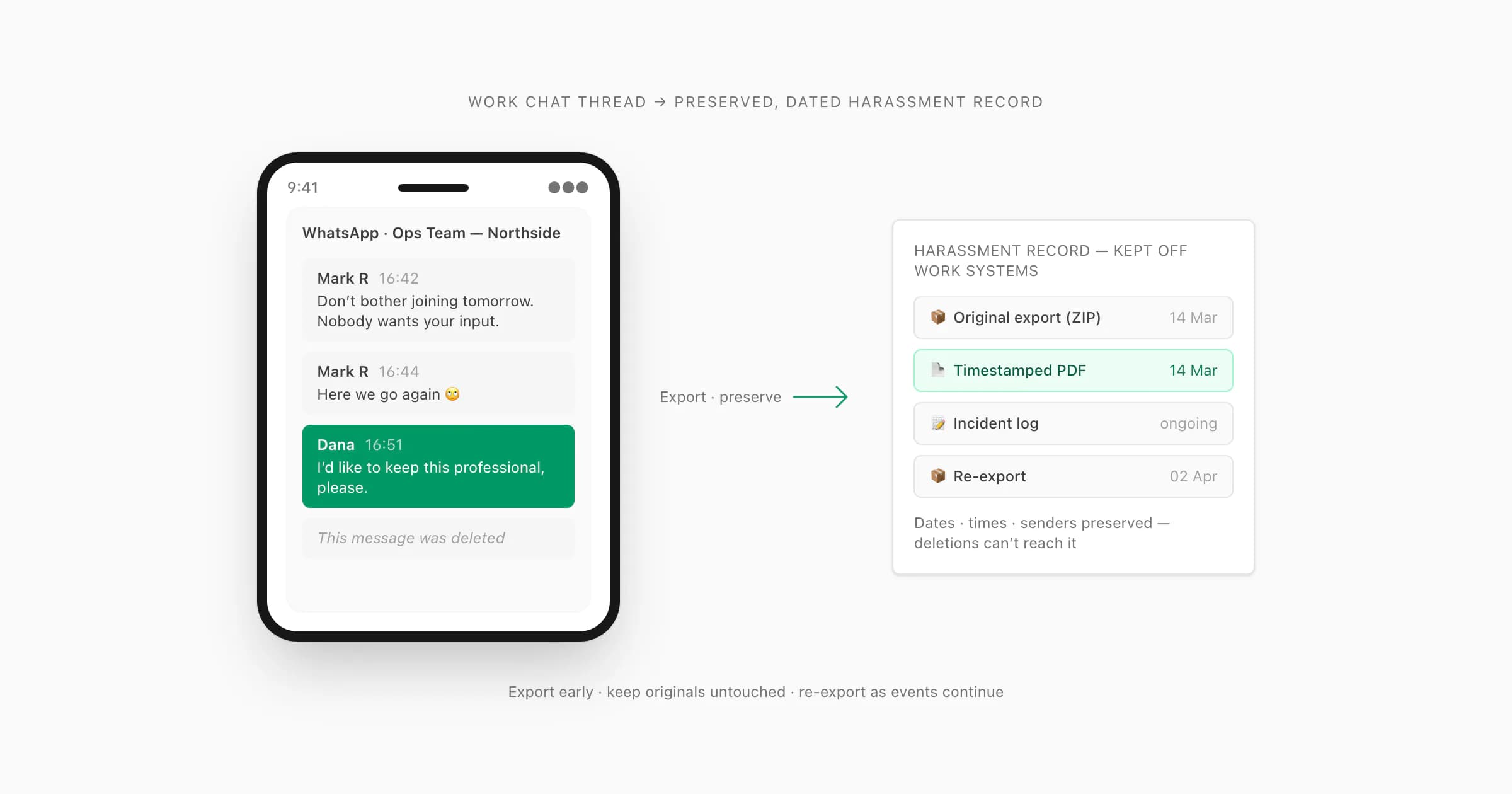
If you need to document workplace harassment messages, the record that carries the most weight is a contemporaneous, complete one: the whole conversation thread, preserved early, in a form that shows dates, times, and who sent what. Export the chat from your own phone now — before anything gets deleted, before you lose access to the account or device — keep the original export untouched, and keep exporting as events continue. A complete record made while events are happening is far stronger than fragments reconstructed from memory later, and it cannot be rebuilt once messages disappear.
On WhatsApp, that means using the built-in Export Chat feature on the conversation or group where the harassment is happening, saving the export file somewhere safe, and turning a copy into a readable, timestamped PDF that HR, a union rep, or a lawyer can actually work through. This guide walks through that workflow step by step, plus the incident log you should keep alongside it.
This guide is about documentation. If messages contain threats of violence or you feel unsafe at work or at home, contact your local police or emergency services first. The record-keeping can wait; your safety cannot.
Why complete, contemporaneous records matter most
I'm not a lawyer, and nothing here is legal advice — but the principle behind this whole guide is one that HR investigators, union reps, and employment lawyers repeat consistently: records made at the time, covering the whole picture, are worth far more than recollections assembled afterwards.
A harassment complaint usually stands or falls on three questions. What exactly was said or done? When, and how often? And can the account be trusted — or could it have been selectively assembled? A complete chat export answers all three at once. It shows every message in the thread with its sender and timestamp, including the ordinary messages around the bad ones, which is exactly what makes the bad ones credible. Context is not a weakness in your record; it is the thing that makes the record believable.
Contemporaneous matters just as much as complete. A thread you exported in March, while the messages were still arriving, documents March. A summary you write in September, after you've resigned and the group has been deleted, documents your memory of March. Investigators treat those very differently, and so do tribunals. The WhatsApp evidence guide goes deeper into why courts weigh verified exports above reconstructions — the same logic applies one step earlier, at the HR stage.
So the single most useful thing you can do, today, is preserve the whole thread in a form that shows dates, times, and senders — and then keep preserving as events continue. Everything else in this guide builds on that.
Why "just screenshot it" is incomplete advice
Search this topic and almost every law firm page says the same thing: take screenshots. It's not wrong — a screenshot is better than nothing, and there are moments (a message you suspect will be deleted in the next five minutes) where a screenshot is the fastest tool you have. But as the foundation of a harassment record, screenshots have two serious gaps.
Screenshots capture moments. Harassment cases are about patterns. A single hostile message can be explained away as a bad day. What usually makes a harassment complaint is frequency and escalation — the same person, week after week, in front of the same group. A folder of forty disconnected screenshots doesn't show that pattern; it shows forty moments with gaps between them, and an investigator has no way to know what was in the gaps. A complete chat export shows the whole timeline: how often it happened, how it escalated, what you said in response, and what the rest of the group saw. I've written about the same problem in the court context in the screenshot vs export comparison — selective fragments invite the question "what are you not showing us?", and a complete thread answers it before it's asked.
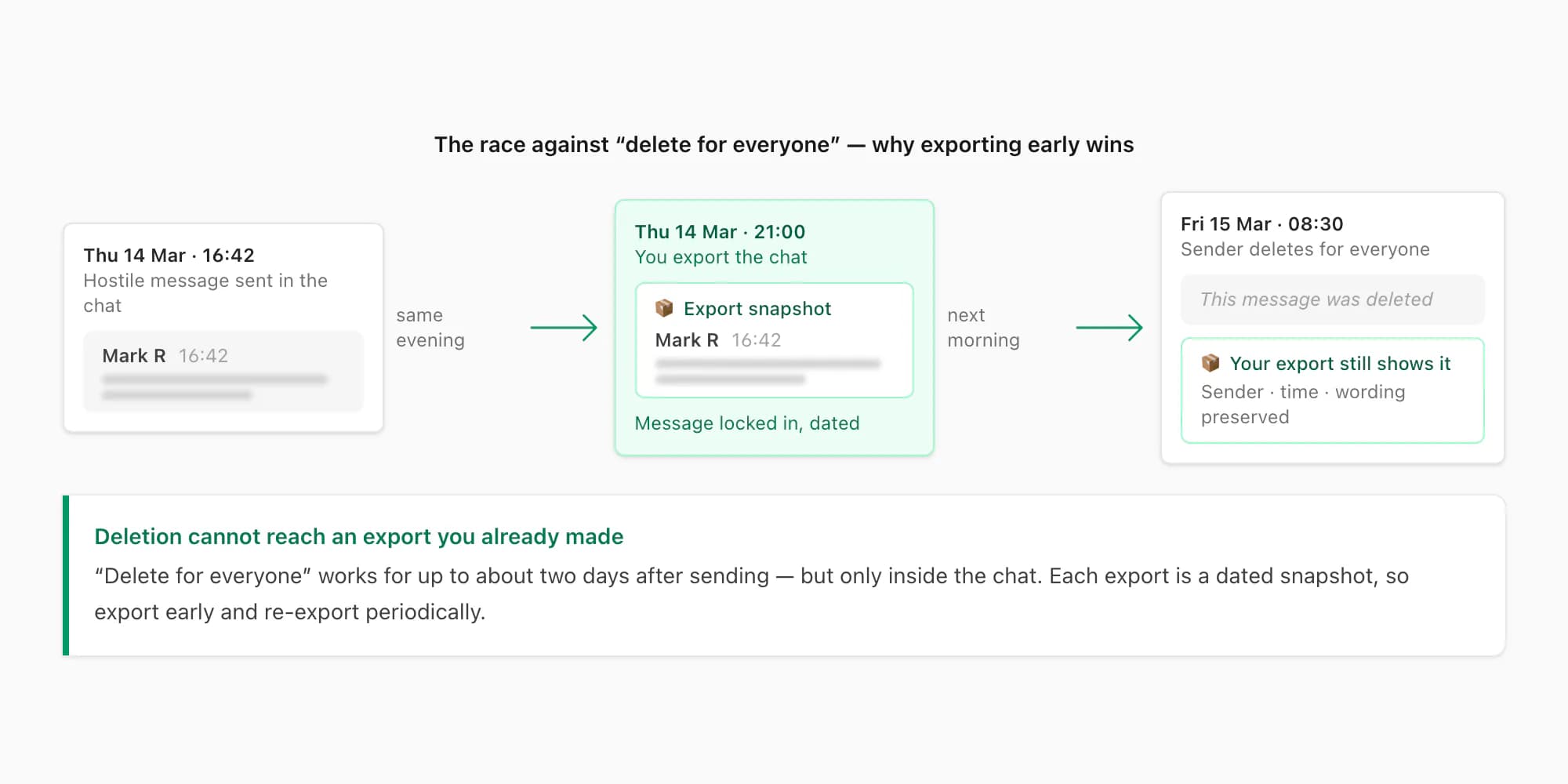
Messages get deleted. WhatsApp's "delete for everyone" removes a message from every phone in the chat — typically within a window of up to about two days after sending, and what remains is just a "This message was deleted" placeholder. If the person harassing you cleans up the thread, the screenshots you didn't take are gone. An export, though, is a snapshot: it preserves whatever was in the chat at the moment you exported. Messages deleted after your export are still in your export. That is why the advice is export early and re-export periodically — each export locks in everything up to that date, and a deletion later only proves something was removed after you preserved it.
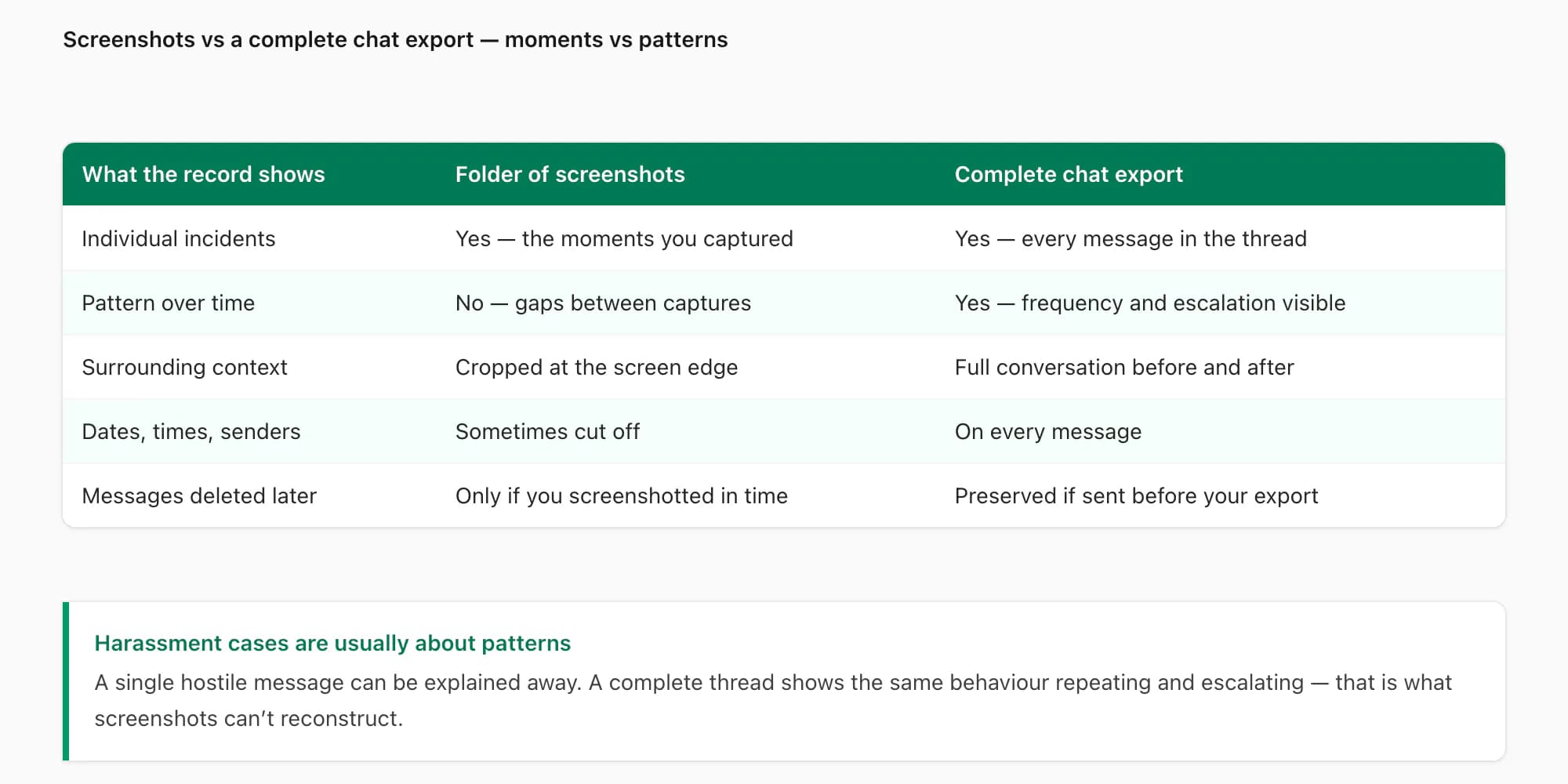
Keep taking the occasional screenshot if it helps you feel covered in the moment. But treat the full export as the actual record.
The preservation workflow
Here is the workflow I'd follow, start to finish. It takes about fifteen minutes the first time and a few minutes for each re-export after that.
Export the chat or group from your own phone
Open WhatsApp on your phone and go to the conversation — the direct chat, or the work group where it's happening. On iPhone: tap the contact or group name at the top → scroll down → Export Chat → choose with or without media. On Android: tap the ⋮ menu → More → Export Chat. Choose "Including Media" if photos or voice notes are part of what you need to document; note WhatsApp caps exports at roughly 10,000 messages with media or 40,000 without, per export. WhatsApp's official export chat FAQ covers the mechanics. Two rules: export from your own account only — never log into someone else's phone or account to collect messages, which can create legal problems far worse than the ones you're solving — and save the export somewhere outside your work-controlled storage (personal email, personal cloud drive, or your own computer).
Keep the original export untouched
The ZIP or TXT file WhatsApp produces is your source record. Don't rename the files inside it, don't edit the text, don't trim it down to "just the relevant parts." Make copies to work from, and leave the original exactly as WhatsApp produced it, with its date. If the matter ever escalates to a tribunal or lawyer, the untouched original is what lets your record be verified. Store at least two copies in places your employer doesn't control.
Make a readable, timestamped PDF
A raw
_chat.txtfile is technically complete but practically unreadable — thousands of unformatted lines that no HR officer is going to scroll through. Upload a copy of the export to chattopdf.app and it becomes a chronological PDF in chat-bubble layout, with every sender name and timestamp preserved, photos inline, and the text searchable. You see a free preview before paying anything, the conversion is a one-time payment per chat ($7–$49 depending on tier), and uploaded files auto-delete within 7 days. This is the document you attach to a complaint: dated, attributed, readable, and printable. The guide to exporting work WhatsApp chats to PDF covers the same conversion from the investigator's side of the table.Keep an incident log alongside the export
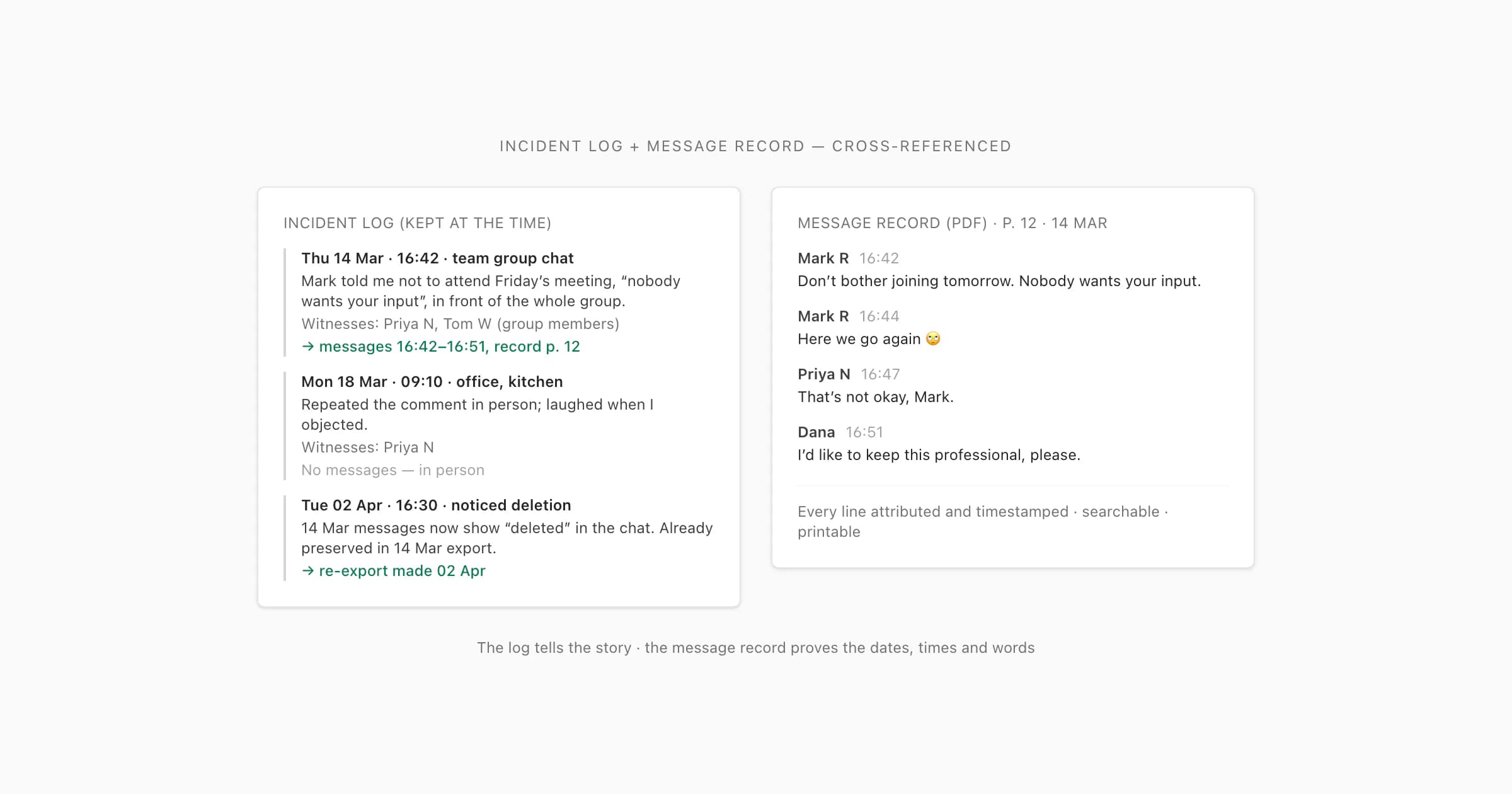
Not everything happens in the chat. Start a simple dated log — a notes file or notebook is fine — and for each incident record: the date and time, what happened, where, who said or did what, who witnessed it, and how it affected you. Where an incident involves messages, cross-reference the log entry to the message date and time so an investigator can flip from your account of an incident straight to the messages themselves. Write entries as soon after each incident as you can; a log kept at the time is itself a contemporaneous record.
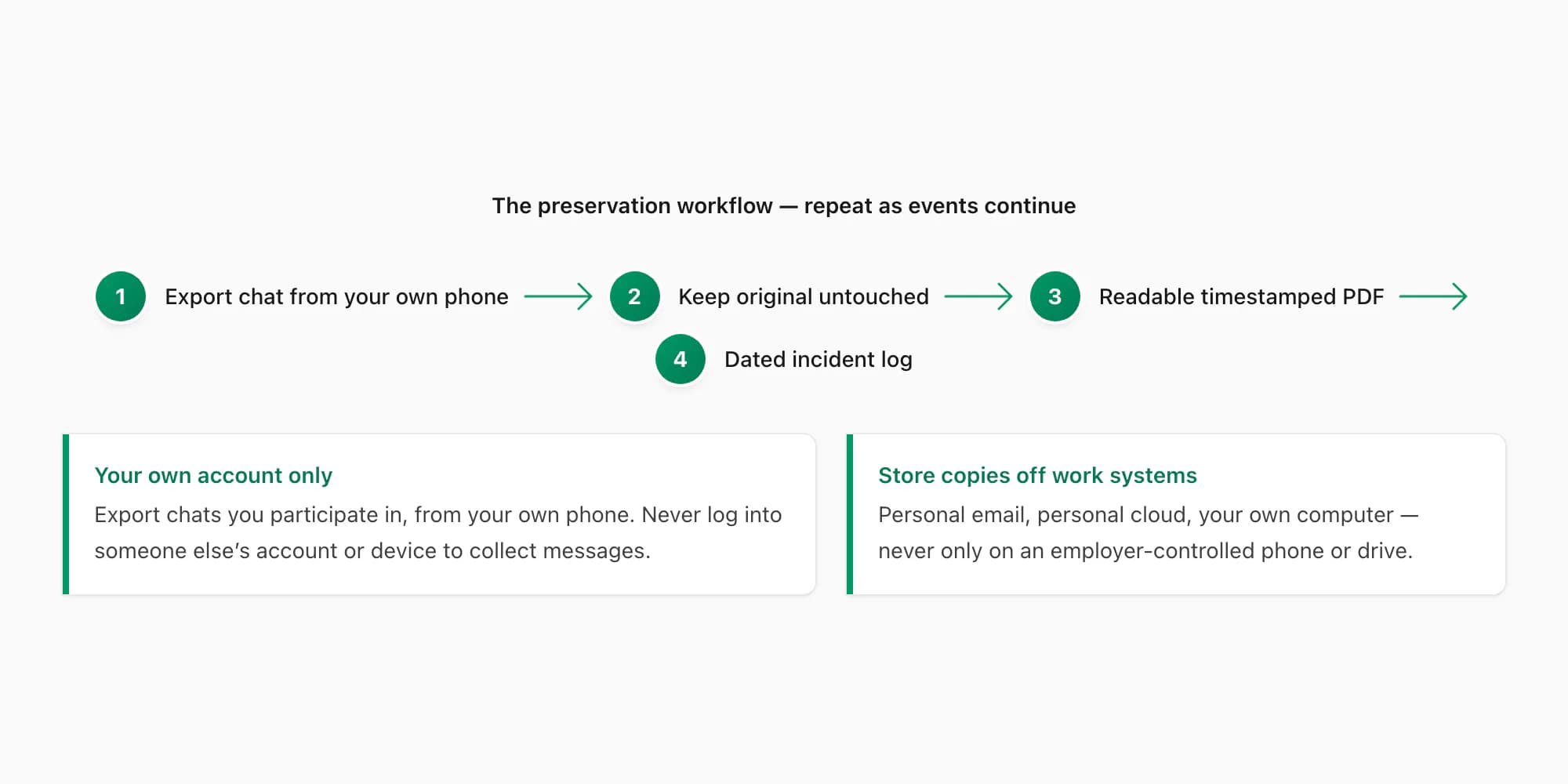
Then repeat step 1 every few weeks while events continue, and again after anything significant. Each export is a dated snapshot; together they show the thread as it stood over time.
Export while you still have access
This is the part people learn too late. Your access to these messages depends on things you may not control for much longer: the phone, the SIM, the number, the account, your membership of the group.
If you resign or are dismissed, a work-issued phone goes back to the employer — with WhatsApp and everything in it. If the number is a company number, the SIM gets reassigned and you can lose the WhatsApp account registered to it. Even on your own phone with your own number, an admin can remove you from the work group; you keep the history that's already on your phone, but the situation is now adversarial and every day adds risk — a lost phone, a failed backup, a "delete for everyone" sweep you can no longer observe.
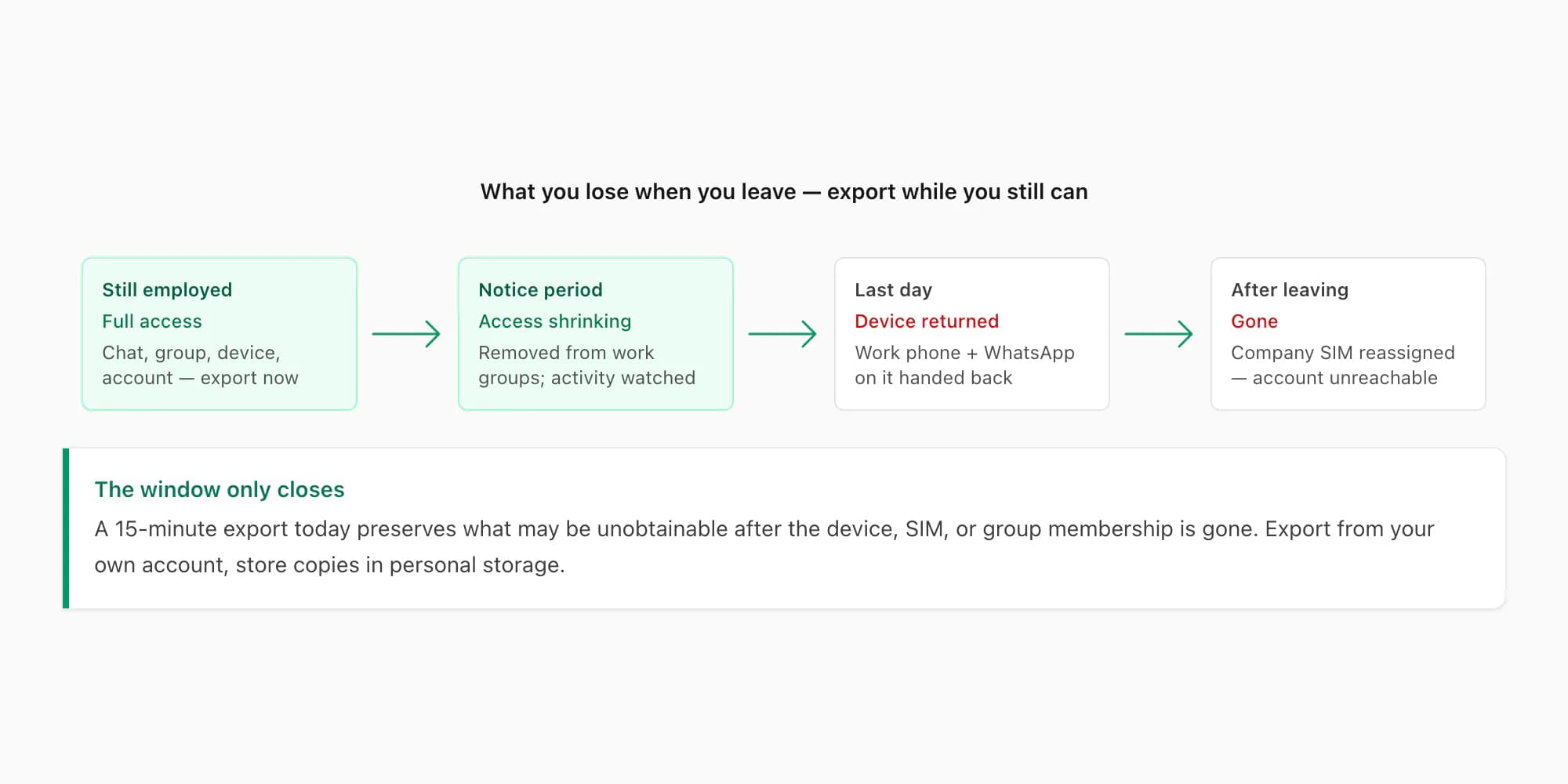
So the rule is simple: export while you have access, not when you need the evidence. If you are reading this while still employed, still in the group, still holding the phone — export today. An export made now costs you fifteen minutes. The same messages after you've handed back the device may be unobtainable at any price.
And the boundary worth restating: this only applies to chats on your own account, that you are or were a participant in. Never log into a colleague's account, never take someone else's phone to collect messages, never ask someone to do it for you on the quiet. If relevant messages exist in chats you're not part of, that's a disclosure question for the formal process — HR investigations and tribunal disclosure have lawful routes to other people's messages. You don't need to become one.
HR teams and tribunals often still ask for paper. A printable WhatsApp chat keeps every message, sender and timestamp in order, and the legal evidence page covers the Formal style for records like this.
Where the record goes: HR, grievance, tribunal
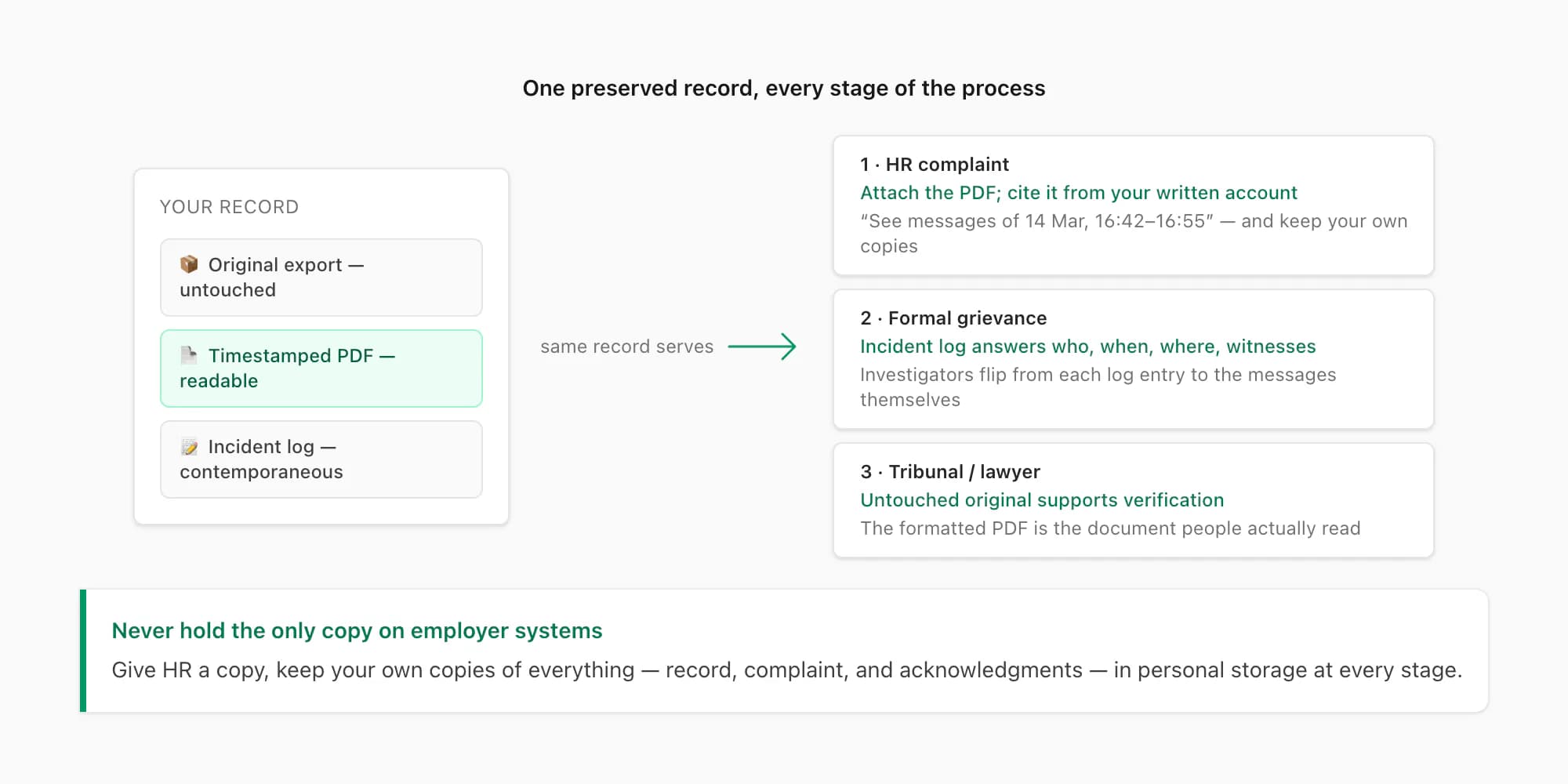
The HR complaint. When you raise a formal complaint, attach the PDF and refer to it from your written account — "see messages of 14 March, 16:42–16:55" reads far stronger than "he often sends hostile messages." Give HR a copy; keep your own copies of everything, including the complaint itself and any acknowledgment. You should never be in a position where the only copy of your evidence lives on your employer's systems.
The grievance process. If the complaint moves into a formal grievance or disciplinary process, the same record serves, and the incident log becomes more important — investigators will ask about specific incidents, dates, and witnesses, and a log you kept at the time answers those questions precisely instead of approximately. Procedures differ a lot between employers and countries; your staff handbook, union rep, or an employment adviser can tell you what your process requires and what deadlines apply. Deadlines for formal claims can be short, so it's worth asking early even if you hope it never gets that far.
Tribunal or legal claim. If it escalates to an employment tribunal or a lawyer, disclosure generally wants complete, readable threads — not curated highlights. This is exactly where the untouched original export plus the formatted PDF earns its keep: the original supports verification, the PDF is what people actually read. Courts commonly accept chat records when they can be authenticated; your lawyer can tell you exactly what your tribunal requires, and the court evidence guide covers formatting, hash verification, and authenticity in detail. The same preservation discipline shows up in other disputes too — the divorce court evidence guide walks through it for family matters, and if some of the harassment happened over SMS rather than WhatsApp, the printing text messages for court guide covers that side. One honest note on scope: ChatToPDF converts exported chats from WhatsApp, Telegram, Instagram, Android SMS (SMS Backup & Restore) and iPhone Messages (iMazing CSV or imessage-exporter) — for Teams, Slack, or email you'll need to preserve those channels by their own export mechanisms.
Harassing voice notes are evidence too
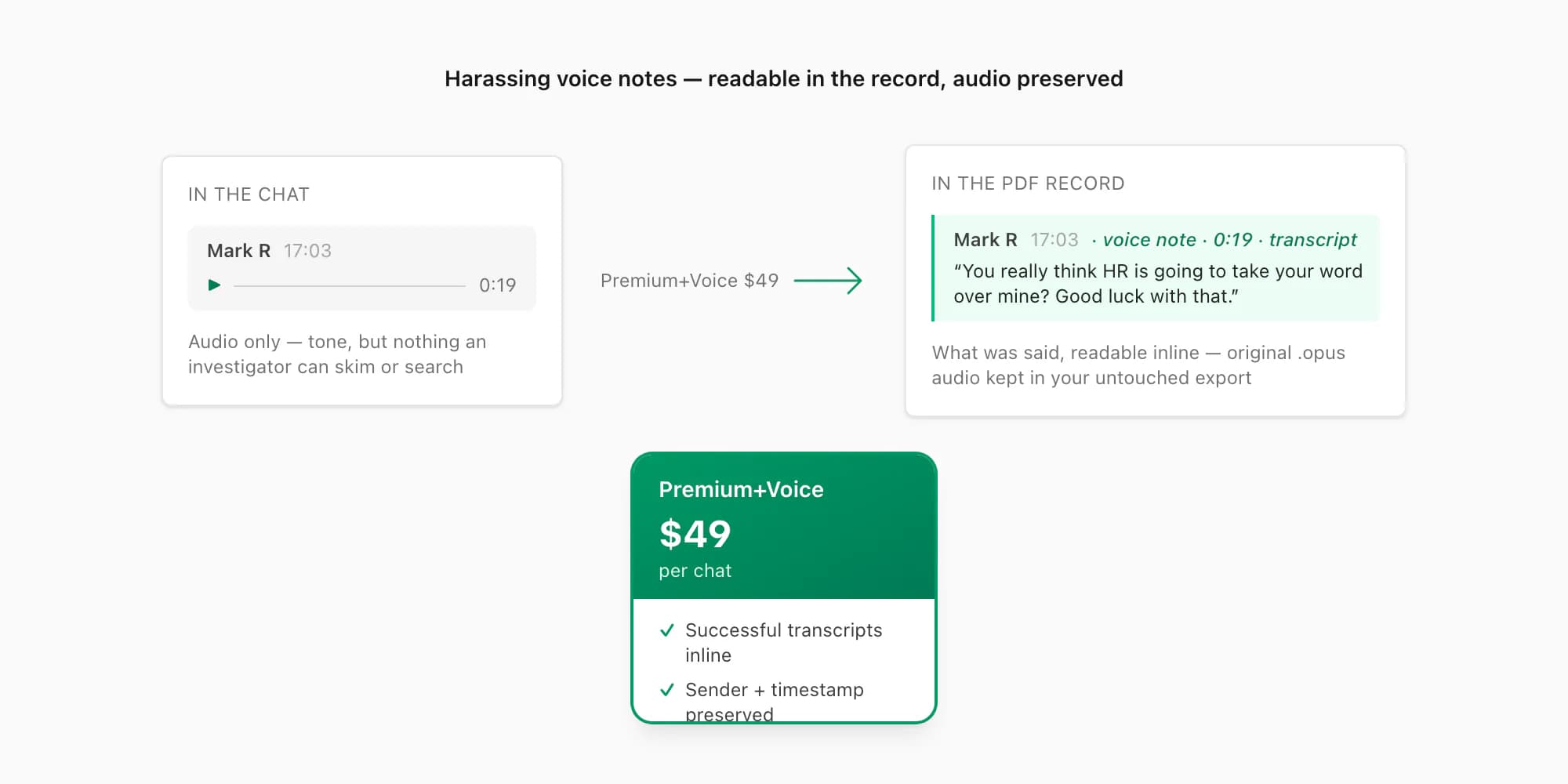
Some of the worst behaviour never gets typed. A voice note has a tone a text can't carry — and people say things into a microphone they'd hesitate to put in writing, precisely because they assume audio is harder to use later. It isn't, if you preserve it properly.
Voice notes are included in a WhatsApp export when you choose "Including Media" — the audio files land in the ZIP alongside the text. Keep those originals with the rest of the untouched export. Then, for the readable record, the $49 Premium+Voice tier processes supported voice notes through the language-aware Nova-3/Scribe v2 router. Notes that transcribe successfully appear as searchable text at their position in the conversation, attributed to the sender and timestamped. An HR officer can review typed and spoken content in one chronology while the original audio remains available for checking tone and wording. The voice-to-text guide covers the current 93-language registry, the 57 provider-published excellent or high bands, and what to expect from noisy recordings.
Do voice notes "count"? In most formal processes, recorded messages the sender chose to send you are treated as communications like any other — but I'd hedge exactly as before: what your specific process accepts is a question for HR, your union rep, or a lawyer. Your job at this stage is just to make sure the audio and a readable account of it both exist and are preserved.
Key takeaways
- Contemporaneous, complete records carry the most weight: preserve the whole thread, early, in a form showing dates, times, and senders — and keep preserving as events continue.
- Screenshots capture moments; harassment cases turn on patterns. A complete export shows frequency, escalation, and context that a folder of screenshots can't.
- "Delete for everyone" removes messages from the chat — but not from an export you already made. Export early, re-export periodically.
- The workflow: export from your own phone → keep the original untouched → convert a copy to a readable, timestamped PDF → keep a dated incident log cross-referencing the message record.
- If you leave the job or are dismissed, you can lose the device, SIM, account, or group access. Export while you still have access — and only ever from your own account.
- Attach the PDF to your HR complaint and keep your own copies of everything. Procedures and deadlines differ; a union rep or employment lawyer can tell you what your process requires.
- Harassing voice notes are evidence too — the $49 Premium+Voice tier makes what was said readable inline in the record, while you keep the original audio.
FAQ
Should I report to HR before or after collecting the evidence?
Preserve first. Exporting the chat takes fifteen minutes and changes nothing visible to anyone else — but once messages are deleted or you lose access to the account, the record cannot be rebuilt. Reporting, by contrast, is a decision you can make on your own timeline and ideally with advice from a union rep, an employment adviser, or a lawyer, because raising a complaint changes the situation: people become careful, threads get cleaned up, and relationships shift. There is no downside to having the export ready before you decide; there is a real downside to deciding to report and then discovering half the thread now says "This message was deleted." One caution: be aware of deadlines. In many places, formal claims have short time limits that run from the events themselves, so don't let careful evidence-gathering become indefinite delay — ask about your deadlines early.
Can I use messages from a work WhatsApp group?
If you are a member of the group, you received those messages legitimately, and exporting a chat you participate in from your own phone is just preserving your own message history. Group messages are often more useful than direct messages in harassment matters, because they show the behaviour happened in front of witnesses — the other members — whose names appear on every message in the export. How a particular employer or tribunal treats group-chat material can vary (some workplaces have policies about work-group confidentiality, and messages involving uninvolved third parties sometimes get redacted later in a formal process), but those are questions for the process, handled by the people running it. They don't change the preservation step: export the group from your own account, keep the original, and let HR or your lawyer decide what gets used and how.
What if the harasser deletes the messages?
WhatsApp's "delete for everyone" removes a message from all phones in the chat, generally within a window of up to about two days after sending, leaving a "This message was deleted" placeholder. After that window, deleting only removes it from the deleter's own phone — your copy stays. Either way, deletion cannot reach into an export you already made: your export preserves whatever was in the chat at the moment you exported it. That's the whole argument for exporting early and re-exporting periodically. If messages are deleted after one of your exports, the export shows what they said, and the placeholders in a later export show that something was removed — which is itself worth noting in your incident log, with the date you noticed.
Can my employer access my WhatsApp messages?
Not from WhatsApp itself — chats are end-to-end encrypted, and your employer has no way to read your account's messages through WhatsApp or your employer's network. The realistic access routes are physical and contractual: if the phone is company-issued, the employer owns the device and can require it back at any time, with everything on it; if the number is a company SIM, they control the number your account is registered to; and if backups go to an account the company controls, they may reach those. That's exactly why the workflow says to export now and store copies in personal storage — personal email, personal cloud, your own computer. If you're documenting harassment on a work-issued device, treat your access as temporary and act accordingly. For what the employer-side process looks like, see the guide to exporting work WhatsApp chats to PDF.
Do voice notes count as evidence?
Generally, a voice note the sender deliberately recorded and sent to you is treated like any other message they sent you — it's a communication, not a secret recording, which is the category that usually raises legal complications. HR processes and tribunals routinely deal with audio messages. The practical issues are preservation and readability: the audio only survives if you export with "Including Media" and keep the original files, and an investigator can only skim it if there's a transcript. The $49 Premium+Voice conversion puts a transcript of each voice note inline in the PDF at its place in the conversation, so the record reads as one document while the original audio stays available for anyone who needs to verify tone or wording. As with everything here, whether and how a specific process uses audio is a question for HR, your union rep, or your lawyer — your job is to make sure it exists when they ask.
I'm Paul, the founder of ChatToPDF. I built it after needing a long WhatsApp conversation as a readable PDF for a legal matter. I test and document WhatsApp exports, PDF conversion, voice-note transcription, and the limits people should check before relying on the result.