
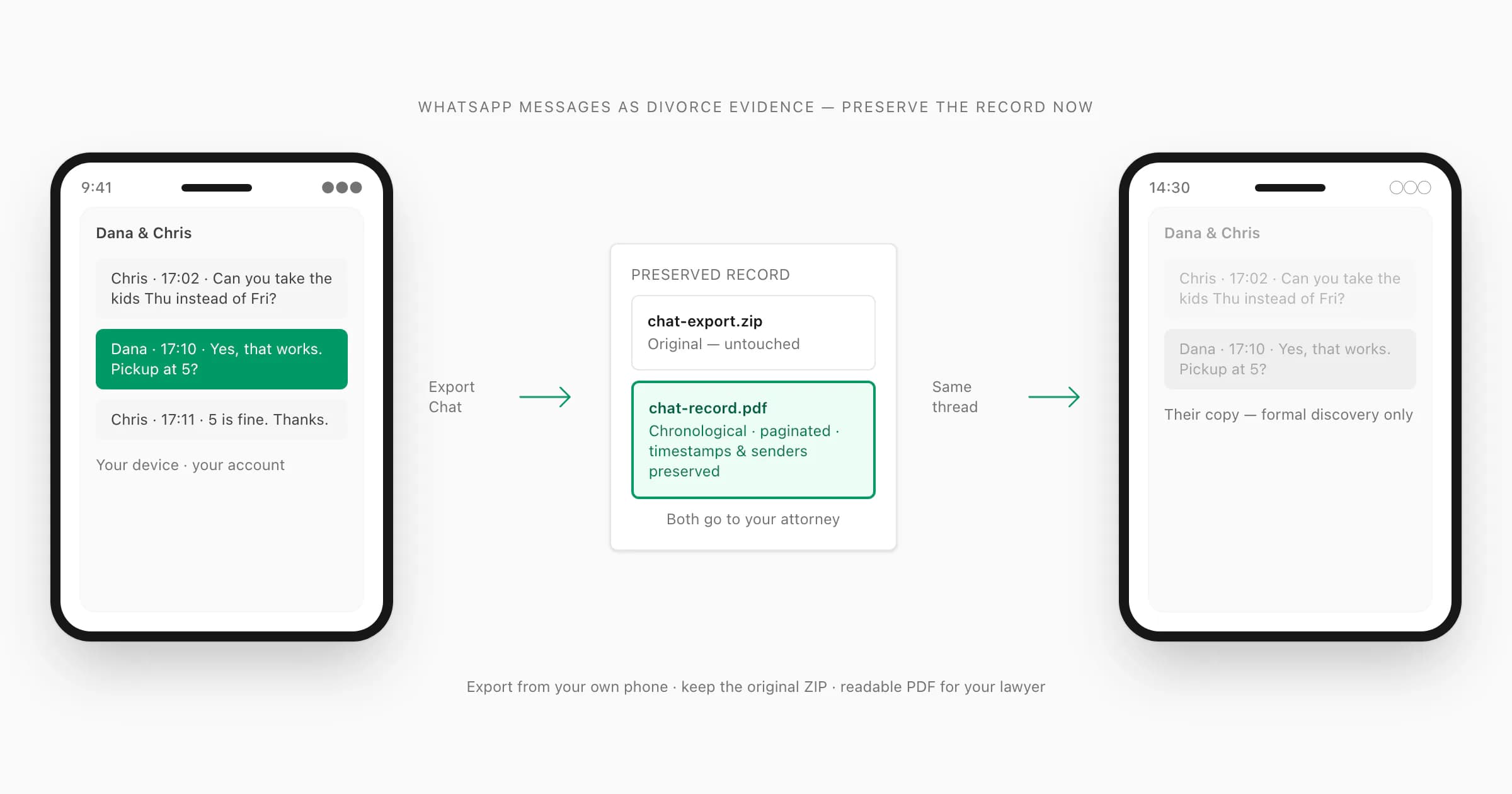
Family courts in many jurisdictions commonly accept WhatsApp messages as divorce court evidence in divorce and custody proceedings — when the messages are authentic, relevant to the matter, and lawfully obtained. Messages between spouses about finances, parenting, agreements, or conduct routinely appear as exhibits in family cases. Whether your messages get in depends on your court's evidence rules and how the messages are presented, which is exactly what your divorce attorney is for.
The practical part — the part you can act on today — is preservation. WhatsApp is end-to-end encrypted, so the copy of the conversation on your own phone is, in most cases, the only complete record that exists. If the phone is lost, upgraded, or wiped before you export, that record can be gone for good. This guide covers what family courts generally look for, the lawful-access line you must not cross, and the exact workflow for preserving WhatsApp conversations so your attorney has something solid to work with.
The lawful-access line: only export from your own device
Before anything else, because this is where people in emotionally charged divorces do real damage to their own cases: only export conversations from your own phone and your own WhatsApp account.
That means chats you were a participant in, sitting on a device you own and control. Your conversations with your spouse, your co-parenting thread, the family group chat you are a member of — all of that lives on your phone lawfully, and exporting it is generally fine. What you must not do is go after the other side's copy:
- Do not unlock your spouse's phone — even if you know the PIN — to read or export their chats.
- Do not log into their WhatsApp account, link it to WhatsApp Web on your laptop, or restore their backup to another device.
- Do not install monitoring or "spy" apps on their phone.
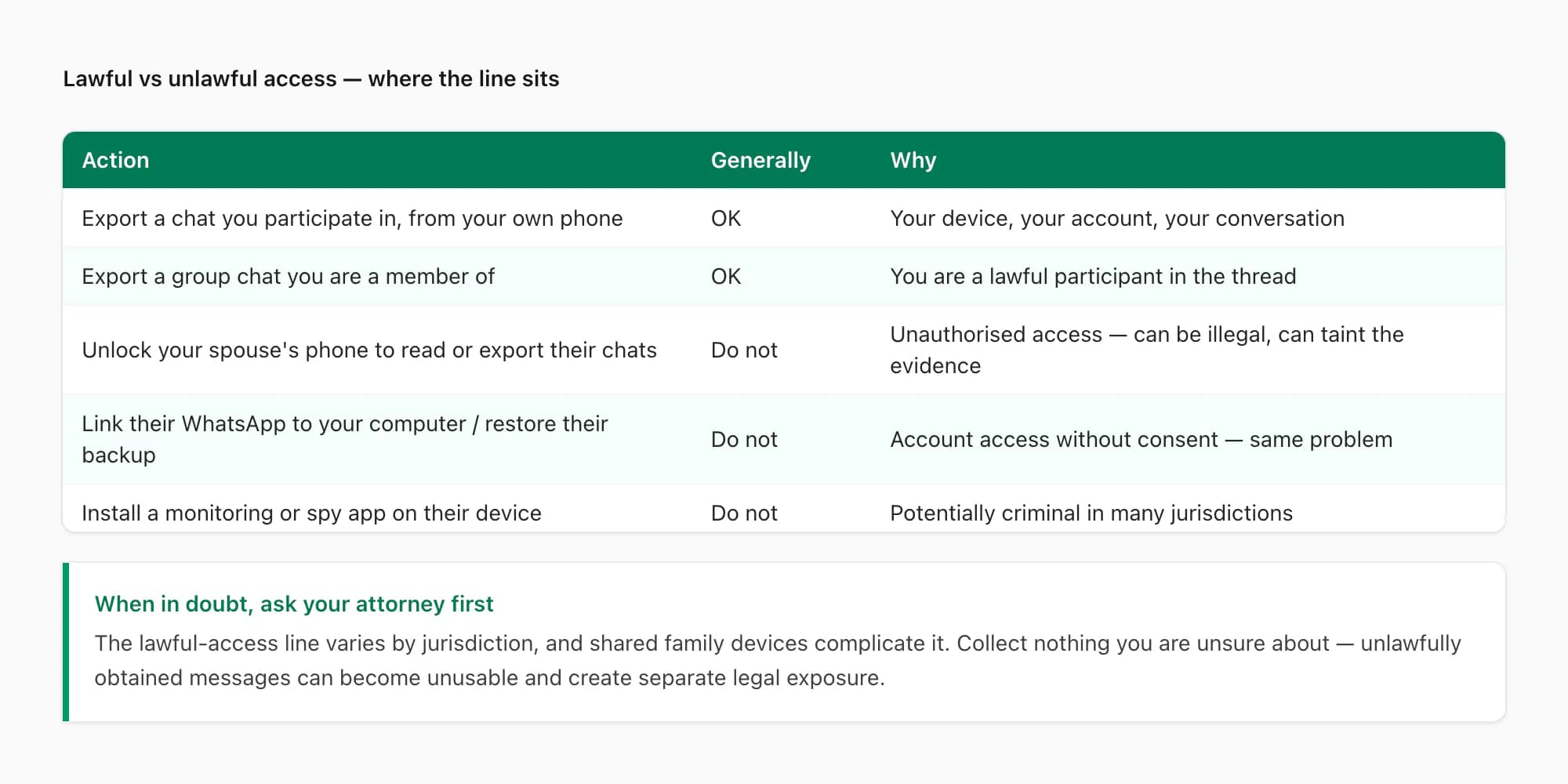
Depending on where you live, accessing someone else's device or account without consent can violate computer-misuse, wiretapping, or privacy laws — in some places it is a criminal offence, separate from the divorce entirely. Even where it isn't prosecuted, family courts can refuse to consider evidence obtained that way, and how you got it becomes its own issue in the case. Family lawyers describe the same pattern over and over: the snooping hurts the snooper more than the messages help.
If you genuinely need messages that only exist on your spouse's side — conversations with a third party, or messages they deleted from the shared thread — that is what formal discovery is for. Your attorney can request them through the court process, with the legal weight to compel production. That route exists precisely so you never have to touch their phone.
I am not a lawyer and this is not legal advice; the lawful-access line varies by jurisdiction, and shared family devices genuinely complicate it. When in doubt, ask your attorney before you collect anything, not after.
What family courts generally look for
So, are WhatsApp messages admissible in divorce court? No tool or article can promise that for your case — be wary of anything that does. What I can tell you is the pattern: courts in many jurisdictions commonly accept WhatsApp and text messages in family proceedings when three things hold.
Relevance. The messages have to matter to an issue in the case — parenting capability, an agreement about money, conduct, timelines. A judge doesn't want 40,000 messages; your lawyer selects what's relevant from a complete record.
Authenticity. You need to be able to show the messages are what you claim they are: actually sent, by that person, at that time, not edited or fabricated. This is where the format of your record matters enormously, and it's the subject of the next section. The US Federal Rules of Evidence, for example, set the authentication baseline in Rule 901 — other jurisdictions have their own equivalents.
Lawful acquisition. Covered above. Messages from your own device and account start on firm ground; messages obtained by accessing someone else's do not.
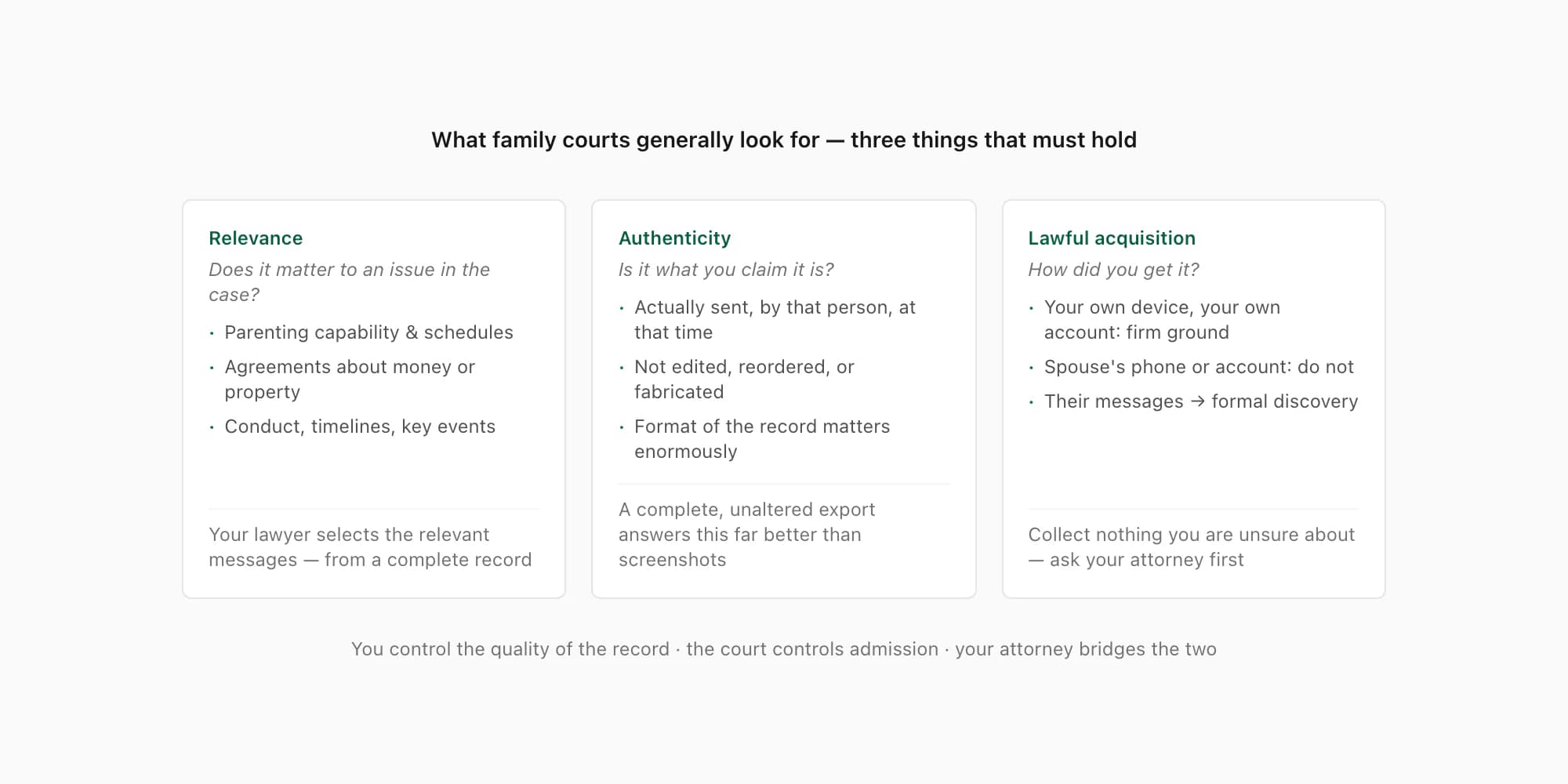
The mechanics of how messages get authenticated and admitted — hash verification, testimony, certification, what your specific court requires — are covered in depth in my WhatsApp evidence for court guide, and the final word always belongs to your attorney and your court's rules.
Why complete exports beat screenshots
When people decide to save messages for a divorce, the instinct is to screenshot the worst ones. I understand the instinct. It is also the weakest possible way to preserve this material.
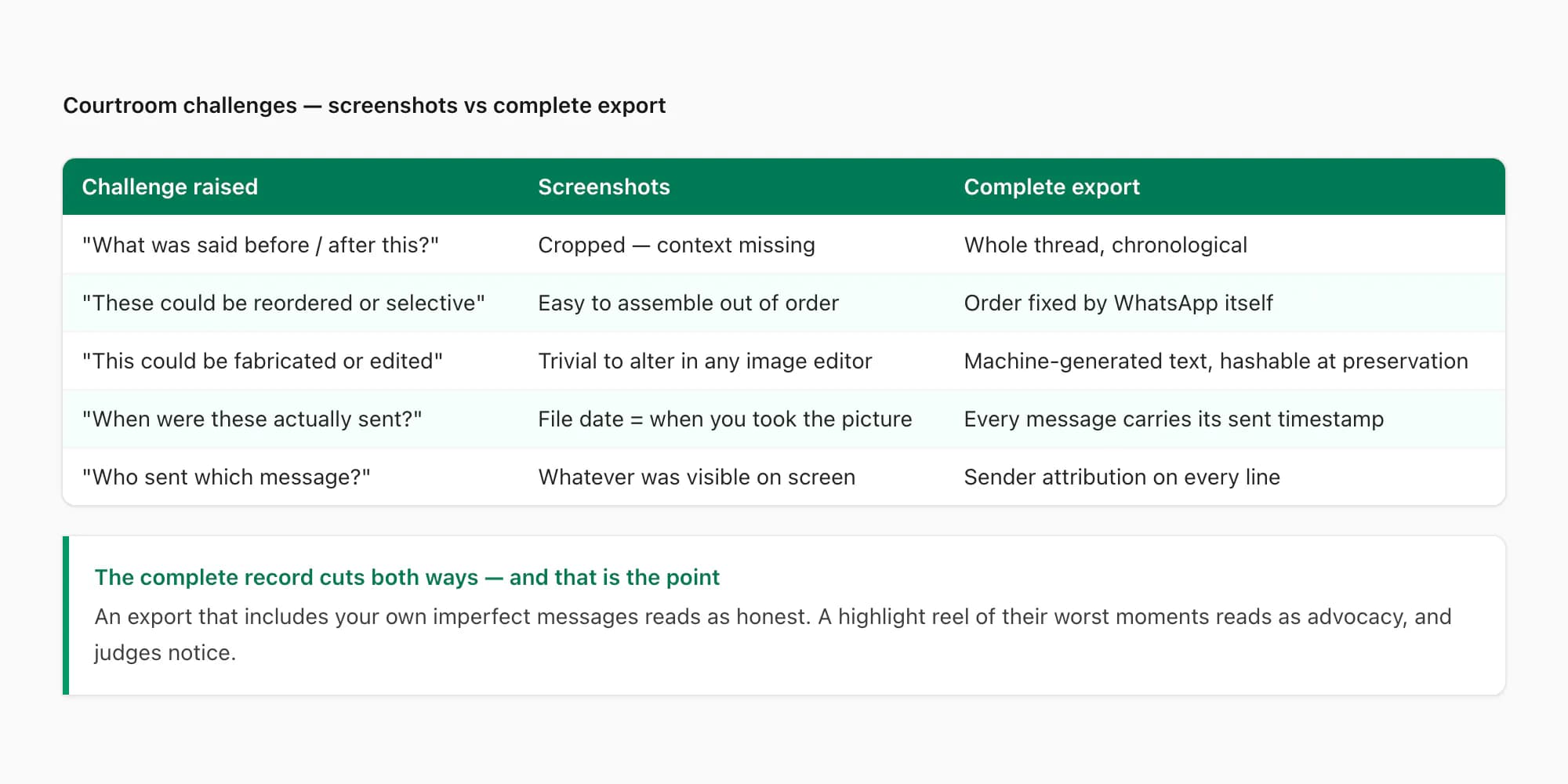
A screenshot is a picture of a screen. It shows a handful of messages with no context, no machine-readable text, and a file timestamp that records when you took the picture — not when the messages were sent. Any image editor can alter one undetectably. In a contested divorce, opposing counsel doesn't have to prove your screenshots are fake; they only have to raise doubt: What was said just before this? Why are these out of order? How do we know this wasn't fabricated? Cropped, cherry-picked screenshots invite every one of those challenges.
A complete export through WhatsApp's own Export Chat feature is a different kind of record. It contains the entire conversation in chronological order — every message, timestamp, and sender attribution — as machine-generated text produced by WhatsApp itself, not by you. There is nothing to crop and no ordering to dispute, because the whole thread is there. The unflattering parts are there too, and that's a feature: a record that includes the messages that don't help you is far harder to dismiss as manipulated. The export file can also be hashed at the moment of preservation, which gives your lawyer a way to demonstrate it wasn't altered afterwards — the evidence guide walks through that hash workflow step by step.
One honest caveat about scope: WhatsApp caps a single export at roughly 40,000 messages without media or 10,000 with media, so multi-year marital threads can mean exporting more than once — your lawyer can advise what period matters. And if some of your evidence is in SMS or iMessage rather than WhatsApp, the preservation logic is the same but the mechanics differ — see how to print text messages for court for that side.
The subpoena reality check: the copy on your phone IS the record
A question I see constantly in divorce forums: "Can't my lawyer just subpoena the WhatsApp messages later?" People assume the messages live on a server somewhere and can be pulled when needed. For WhatsApp, that assumption is mostly wrong, and relying on it is how evidence gets lost.
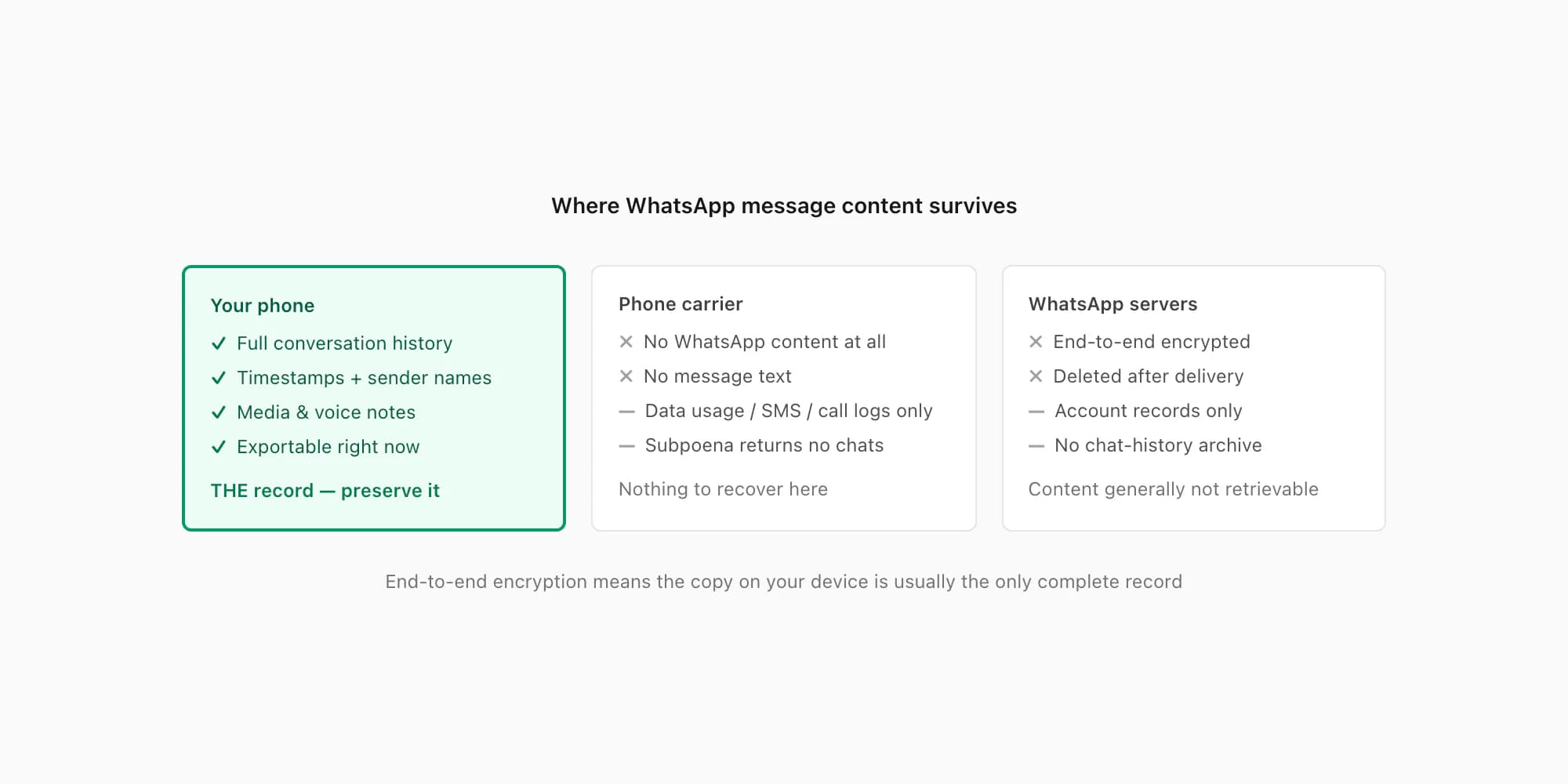
Here is what actually exists where:
Your phone carrier has no WhatsApp content at all. WhatsApp messages travel as encrypted internet data, not SMS. A carrier subpoena can show data usage, calls, and SMS records — but not a single WhatsApp message.
WhatsApp's servers hold very little message content. WhatsApp is end-to-end encrypted; messages are deleted from servers on delivery, and undelivered ones are held only temporarily. Lawyers can serve legal process on WhatsApp, but what's generally available is account and usage records — not your conversation history. (Cloud backups, where they exist and aren't end-to-end encrypted, are a partial exception your attorney can explore — but they're a maybe, not a plan.)
Your phone has everything: the full conversation, exportable right now through WhatsApp's built-in Export Chat feature.
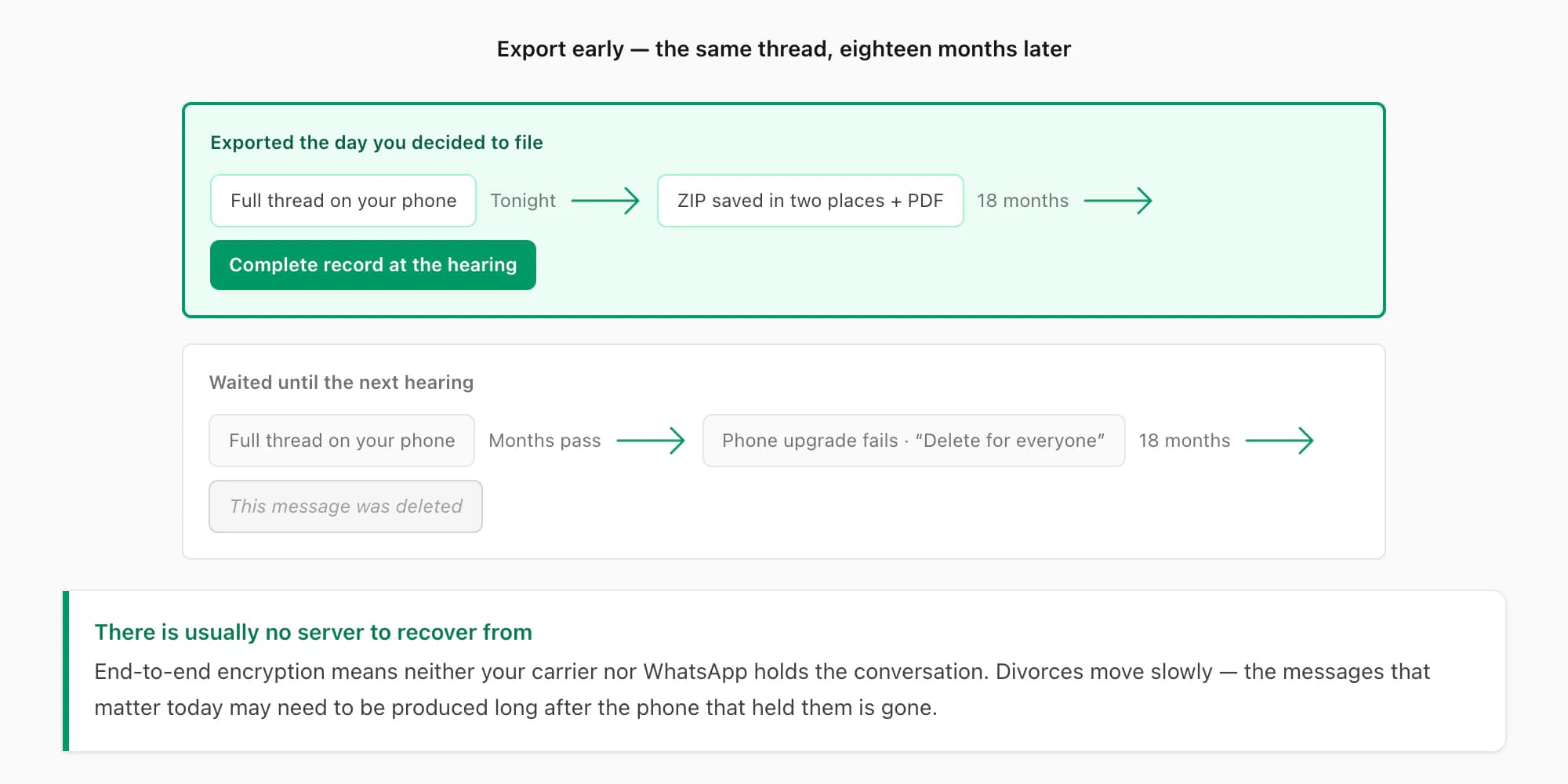
The practical consequence is blunt: the copy of the conversation on your device is, for most purposes, the record. If you upgrade phones and the transfer fails, if the phone is lost or damaged, if your spouse deletes messages for everyone, or if an account is deleted — the record degrades or disappears, and there is usually no server to recover it from. Divorces also move slowly; the conversation that matters today might need to be produced eighteen months from now. Export early. Tonight, not after the next hearing.
The preservation workflow
This is the workflow I'd give a friend on the day they decide to file — simple enough to do in an evening, rigorous enough that your attorney gets something they can actually use.
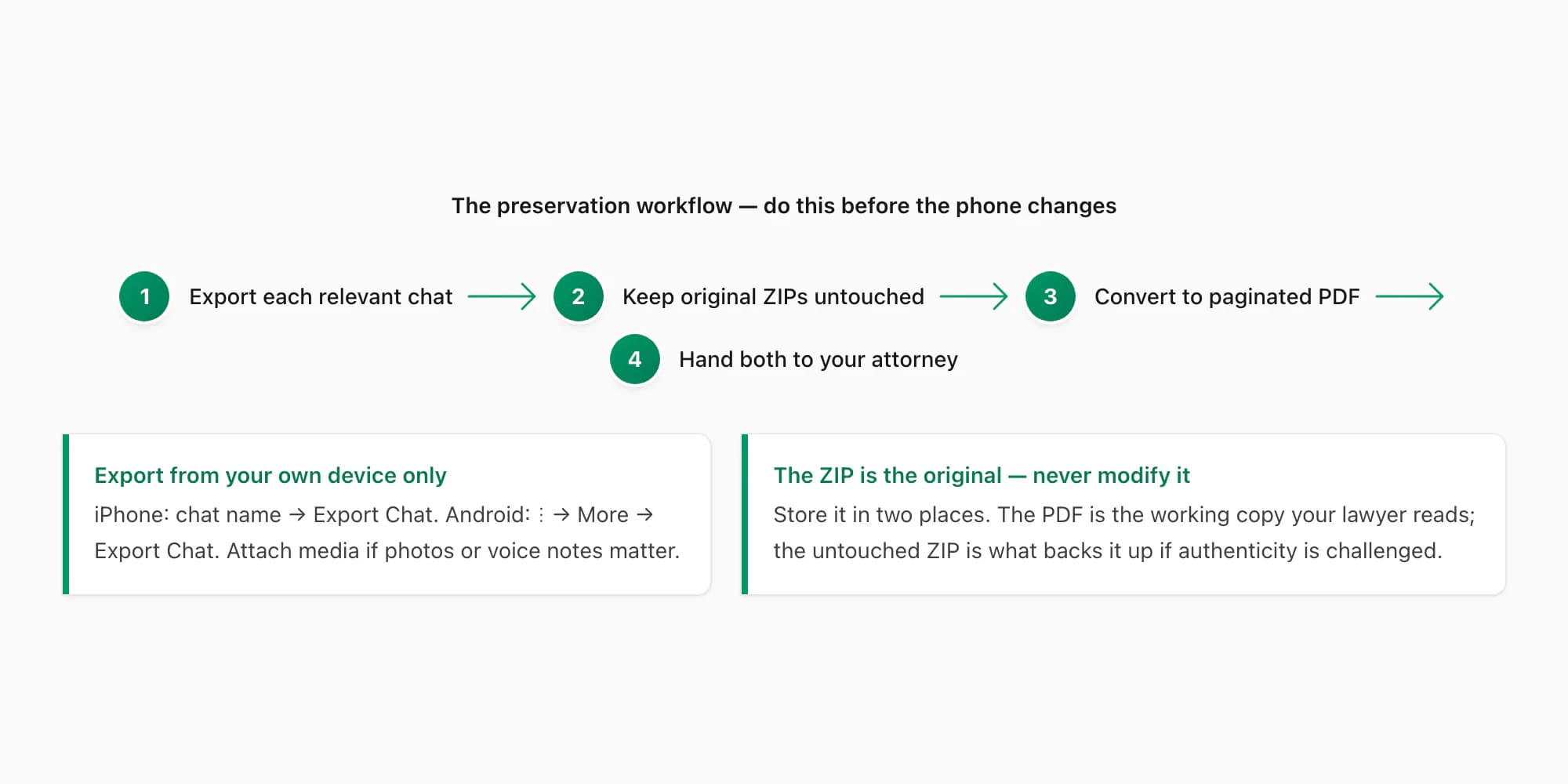
Export each relevant chat from your own phone
Identify every conversation that could matter: the thread with your spouse, the co-parenting chat, relevant family group chats you belong to. For each one — on iPhone: open the chat, tap the contact or group name at the top, scroll down, tap Export Chat; on Android: tap the ⋮ menu → More → Export Chat. Choose Attach Media if photos or voice notes are part of the story (export caps at ~10,000 messages with media, ~40,000 without — for very long threads, ask your lawyer which period matters most). Save each ZIP somewhere durable: Files app, Google Drive, or email it to yourself.
Keep the original ZIPs untouched
The export ZIPs are your originals — the anchor of the whole record. Copy them to at least two places (cloud storage plus a computer or external drive), and then leave them alone. Don't rename them, don't unzip-and-rezip them, don't "tidy them up." If authenticity is ever challenged, the unmodified original export is what your attorney falls back on.
Convert each export into a readable, paginated PDF
Nobody — not your attorney at their hourly rate, not a judge — wants to read a raw
_chat.txtfile. Upload each ZIP to chattopdf.app and you get back a chronological, paginated PDF: chat-bubble layout, every sender name and timestamp preserved, photos inline, fully searchable text. You see a free preview before paying anything; conversion is a one-time fee per chat ($7–$29 for text-and-photos tiers), and uploaded files auto-delete within 7 days. If voice notes carry part of the story, the $49 Premium + Voice tier transcribes each one inline where it was sent. The full conversion walkthrough is in the WhatsApp to PDF guide.Hand both to your attorney — the PDFs and the original ZIPs
The PDF is the working document your lawyer reads, annotates, and selects exhibits from. The ZIP is the source that backs it up. Give your attorney both, tell them when and from which device each export was made, and let them decide what gets used, what gets redacted, and how it gets introduced. From this point on, presentation is legal work, not formatting work.
When the bundle has to be printed, print the WhatsApp chat as paginated pages rather than screenshots, and keep the original ZIP beside it. The legal evidence page shows the Formal layout I use for this.
Custody cases: co-parenting records and the whole-thread rule
Custody disputes are where WhatsApp records show up most, because the co-parenting thread is the documentary record of the parenting relationship: who asked for schedule changes, who showed up late, who paid for what, what tone each parent takes. Three things I'd want anyone in a custody matter to internalise.
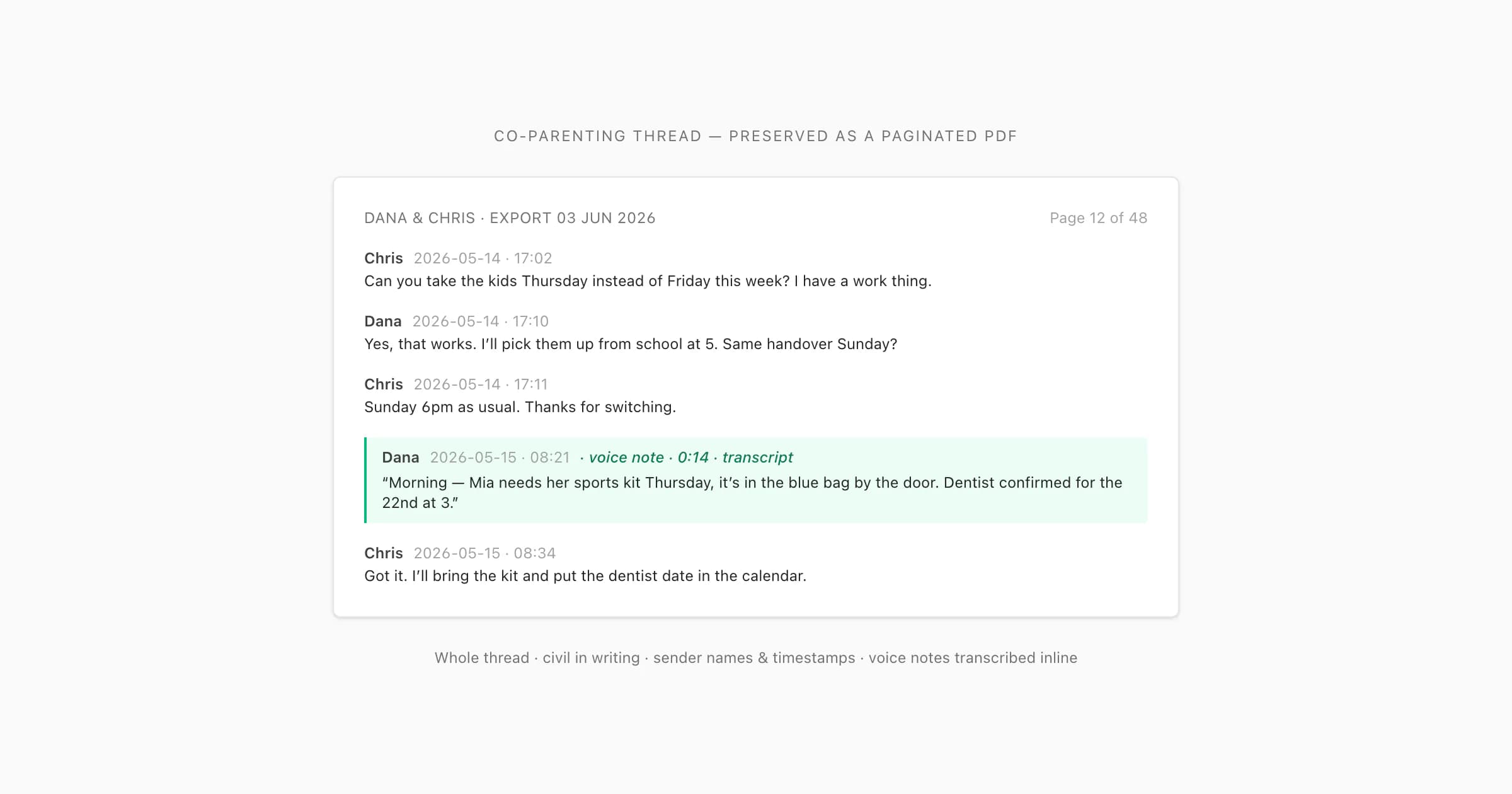
Keep the whole thread, not the highlights. The temptation is to preserve the five messages where your ex was awful. But judges and evaluators read these threads in context, and they notice cherry-picking — a curated excerpt invites the obvious question of what was left out, and the other side will happily supply the answer. A complete export that includes your own less-than-perfect moments reads as honest; a highlight reel reads as advocacy. Export the whole conversation and let your attorney do the selecting.
Your own messages are evidence too. Every message you send to your co-parent from today onward may eventually be read aloud in a courtroom with you sitting there. So write accordingly: civil, brief, factual, focused on the children and logistics. Family lawyers put it as "write every message as if the judge is reading it" — because one day a judge might. A calm thread of yours next to a hostile thread of theirs is quietly powerful; matching their tone throws that advantage away.
Voice notes count too. Co-parenting conflict often happens in voice notes rather than text — and a voice note in a folder of audio files is nearly invisible to a lawyer skimming a record. If you export with media, the $49 Premium + Voice conversion processes supported notes; successful transcripts appear inline in the PDF, attributed and timestamped, so spoken exchanges sit readably inside the conversation. More detail in the WhatsApp voice-to-text guide.
The same complete-record logic applies well beyond custody — the documenting workplace harassment guide covers the employment version of this exact discipline.
The curation-and-labeling logic here carries over to other formal processes: the same export-keep-format workflow is what immigration applications expect when WhatsApp chats serve as relationship evidence.
Key takeaways
- Family courts in many jurisdictions commonly accept WhatsApp messages in divorce and custody cases when they're relevant, authentic, and lawfully obtained — your attorney confirms what your court requires.
- Only export chats from your own device and account. Accessing a spouse's phone or account without consent can be illegal and can make the evidence unusable; their messages are what formal discovery through your attorney is for.
- WhatsApp is end-to-end encrypted: message content generally can't be pulled from your carrier or from WhatsApp's servers later. The copy on your phone is the record — export before a phone upgrade, loss, or deletion takes it away.
- Complete exports beat screenshots: the full chronological thread with timestamps and sender names resists cropping, ordering, and fabrication challenges that screenshots invite.
- Workflow: export each relevant chat → keep the original ZIPs untouched in two places → convert each to a readable paginated PDF → hand both PDFs and ZIPs to your attorney.
- In custody matters, preserve the whole thread (judges notice cherry-picking) and write every co-parenting message knowing it may be read in court — your messages are evidence too.
FAQ
Are WhatsApp messages admissible in divorce court?
They commonly are, in many jurisdictions — family courts regularly see WhatsApp and text messages as exhibits when the messages are relevant, can be authenticated, and were lawfully obtained. But admissibility is decided case by case under your court's evidence rules, so no article or tool can promise your messages will be admitted, and you should distrust any that does. What you control is the quality of the record: a complete, unaltered export from your own device gives your attorney the strongest starting material. Whether and how it comes in is their job and the court's call.
Can deleted WhatsApp messages be recovered for a divorce case?
Usually not from the export, and usually not from WhatsApp. If your spouse used "Delete for everyone," the export shows only a "This message was deleted" placeholder — and WhatsApp's servers don't keep delivered message content, so there's no archive to subpoena it back from. The realistic routes are the other party's own device (reachable through discovery), an older phone backup made before the deletion, or testimony about what the message said — all of which run through your attorney. The reliable defence is speed: export relevant chats before messages can be deleted. The placeholder itself at least shows something was deleted at that point in the thread.
Can my spouse subpoena my WhatsApp messages?
Not from WhatsApp or your carrier in any useful way — end-to-end encryption means neither holds your message content. But your spouse's attorney can typically seek your messages from you through discovery: a court can order you to produce relevant conversations from your own device. Two things follow. First, never delete messages once litigation is underway or reasonably anticipated — destroying potential evidence can carry serious consequences of its own. Second, they already have their own copy of every chat you shared with them. Assume anything you wrote in the marriage can surface, and let your attorney handle what must be produced.
Should I screenshot my WhatsApp messages or export them for my lawyer?
Export, almost always. Screenshots show fragments without context, carry no machine-readable metadata, and are trivially editable — which means cropping, ordering, and fabrication challenges are easy for the other side to raise. WhatsApp's Export Chat feature produces the entire conversation as machine-generated text with every timestamp and sender name intact, which answers those challenges structurally. Screenshots still have a place as a quick stopgap — a status that's about to disappear, a chat you fear will be deleted in the next hour — but follow up with a full export as soon as you can. Then convert the export to a paginated PDF so your attorney can actually read, search, and cite it.
What about voice notes — can those be used in a divorce case?
Voice notes are part of the conversation and courts treat them as potentially relevant communications like any other message — the same authenticity, relevance, and lawful-access considerations apply, and your attorney advises on use. Practically, the challenge is making them readable: a folder of .opus audio files is painful for a lawyer to review and impossible to search. If you export the chat with media included, the voice note files are inside the ZIP, and ChatToPDF's $49 Premium + Voice tier transcribes every one inline in the PDF — each transcript attributed to its sender at its timestamp, sitting in the flow of the conversation where it was sent. Spoken exchanges become readable, searchable text alongside the written messages, with the original audio files still preserved in your untouched ZIP.
I'm Paul, the founder of ChatToPDF. I built it after needing a long WhatsApp conversation as a readable PDF for a legal matter. I test and document WhatsApp exports, PDF conversion, voice-note transcription, and the limits people should check before relying on the result.